- All
- Product Name
- Product Keyword
- Product Model
- Product Summary
- Product Description
- Multi Field Search

Views: 0 Author: Site Editor Publish Time: 2026-10-02 Origin: Site


Machining and finishing aluminum presents a unique set of challenges for any fabricator. The most notable hurdle is the rapid degradation of hand tools through a process known as "pinning." Aluminum is soft and seemingly easy to work with on the surface. However, its metallurgical properties actively fight against standard abrasive and cutting tools. You might expect a simple pass to smooth a rough edge. Instead, you often find your tool instantly ruined by trapped debris.
This guide breaks down the precise physical causes of metal file clogging on aluminum. We standardize prevention techniques to help keep your production lines running efficiently. We also establish clear evaluation criteria for selecting and maintaining the right tools for non-ferrous finishing. You will learn how to anticipate these material behaviors. By implementing these practical steps, you can stop this frustrating issue before it damages your workpieces.
The Root Cause: Aluminum’s high ductility and low melting point cause it to micro-weld into file teeth under friction.
Prevention over Correction: Pre-treating files with chalk or dedicated cutting fluids is significantly more efficient than mid-process cleaning.
Tool Selection Matters: Standard double-cut files fail quickly on aluminum; curved-tooth (Vixen) or specialized single-cut files are required for scalable production.
Maintenance Protocol: Proper steel file cleaning requires directional brushing with a file card and soft-metal picks to avoid damaging the file’s hardened steel cutting edges.
To solve the problem, we must understand the metallurgical reality of aluminum. Aluminum alloys, particularly common grades like 3003 or 5052, are highly ductile. Ductility means the metal stretches and deforms easily under stress. When you cut cast iron, it fractures into fine, brittle dust. When you cut aluminum, it shears into long, continuous chips. This gummy nature is excellent for extrusion. However, it creates severe mechanical problems during manual finishing.
Friction and heat drive this failure process. The physical action of filing generates intense, localized heat across the tool face. Aluminum possesses a relatively low melting point compared to steel. As you push the tool across the workpiece, these continuous aluminum chips soften rapidly. They lose their structural integrity. The pressure forces them into the gullets, which are the deep valleys between the cutting teeth.
Once trapped, a destructive process called micro-welding begins. Machinists often refer to this as galling. The combination of extreme pressure and frictional heat causes the soft aluminum to bond physically to the hard steel. It is no longer just loose debris. The aluminum fuses into solid "pins." These pins protrude above the actual cutting teeth. Your tool instantly stops cutting and begins dragging.
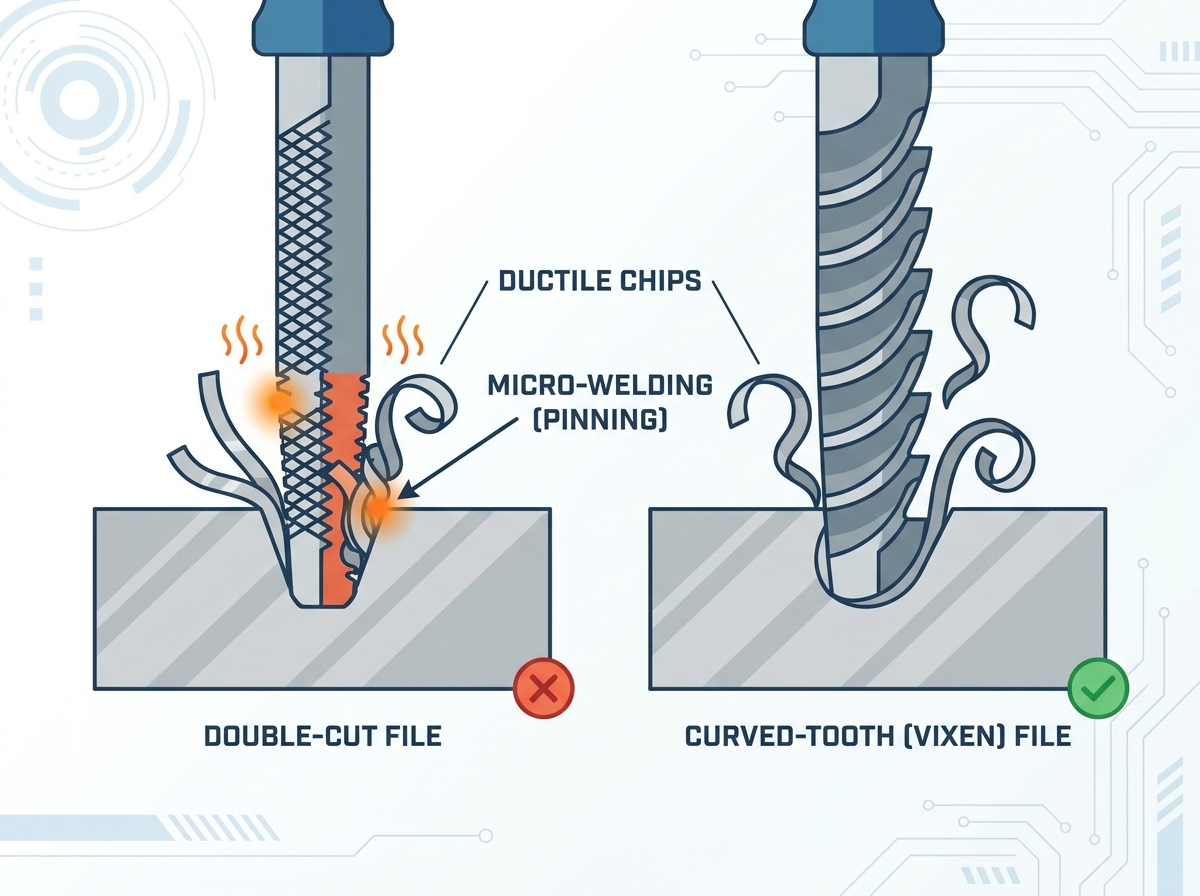
Pinning turns a precision cutting tool into an abrasive liability. Trapped aluminum nodules sit higher than the steel teeth. When you push the file forward, these hardened nodules score the workpiece. They dig in and leave deep, irregular scratches across your pristine aluminum surface. This surface finish degradation requires costly rework. Teams must spend extra time sanding out deep gouges. In strict manufacturing environments, these scratches often cause outright part rejection.
Tool lifespan and operator fatigue also suffer dramatically. Clogged files stop removing material efficiently. Operators naturally respond by applying more downward pressure. They try to force the dull tool to bite into the metal. This extra pressure increases friction and heat even further. It accelerates the galling process. It also rapidly exhausts the worker. Ergonomic efficiency plummets when teams fight their own tools.
We must frame this business problem around hidden downtime. Think about the exact minutes operators spend picking aluminum out of standard tools every day. That wasted labor accumulates quickly. The cost of this daily downtime outweighs the price of investing in application-specific tools. It also justifies spending time on preventative processes. Ignored maintenance directly impacts your bottom line.
Preventing build-up is always more efficient than removing it. You can employ several highly effective techniques to keep your tools cutting smoothly. We strongly recommend building these habits into your daily workflow.
The "Chalking" method is a traditional, dry lubrication strategy. You rub ordinary blackboard chalk into the tool before use. The chalk powder fills the empty gullets completely. It leaves only the sharp cutting edges exposed. Because the valleys are full of chalk, sheared aluminum cannot find an anchor point. It simply falls away from the work area. This method is incredibly effective and very cheap.
Wet lubrication offers another robust approach. You can use dedicated cutting fluids, WD-40, or specialized non-ferrous machining waxes. Let us evaluate wet versus dry methods.
Dry Lubrication (Chalk): Keeps parts free of oil. Requires frequent reapplication. Best for immediate welding preparation.
Wet Lubrication (Fluids/Wax): Provides a superior surface finish. Prevents galling beautifully. Requires thorough solvent cleaning before painting or welding.
Stroke technique and discipline remain absolutely critical. You must consciously lift the tool on the return stroke. Dragging it backward does not cut any material. Instead, the backward motion actively forces sheared aluminum deeper into the teeth. Strict stroke discipline prevents premature wear. It allows the chips to fall clear of the work zone.
Tool geometry dictates your success when working with non-ferrous alloys. A generic double-cut flat steel file is designed specifically for ferrous metals like iron or steel. Its cross-hatched pattern creates tiny, enclosed diamond-shaped pockets. These tight pockets trap soft chips instantly. Using one on aluminum guarantees immediate failure and frustration.
Curved-tooth files, often called Vixen files, are the industry standard for soft alloys. Automotive body technicians originally popularized them. They feature deep, wide gullets. Their aggressive shearing angle slices material cleanly. This open geometry allows continuous chips to clear out the sides naturally. They resist packing completely. They leave a smooth, milled-like finish on soft metals.
If a Vixen file is unavailable, evaluate your alternatives carefully. A coarse, single-cut bastard file works reasonably well for light tasks. The single-directional teeth lack restrictive cross-hatching. This open spacing minimizes the trapping zones for ductile chips. Always prioritize open geometries for soft, gummy materials.
Comparison of File Geometries for Non-Ferrous Alloys
Tooth Design | Chip Clearance | Risk of Pinning | Ideal Application |
|---|---|---|---|
Double-Cut Flat | Very Poor | Extreme | Hard steel, cast iron, brass |
Single-Cut Bastard | Moderate | Medium | General sharpening, light aluminum deburring |
Curved-Tooth (Vixen) | Excellent | Very Low | High-volume aluminum fabrication, lead shaping |
Even with excellent preventative measures, occasional clogging happens. Proper steel file cleaning demands specific tools and highly disciplined techniques. You must protect the high-carbon steel edges at all times.
First, master the file card application. A file card is a specialized brush featuring short, stiff wire bristles. You must brush strictly parallel to the cut of the teeth. This directional sweeping pushes debris out of the gullets efficiently. Brushing randomly or diagonally across the teeth accomplishes nothing. It simply dulls the sharp edges over time.
For precision de-pinning, you need soft-metal tools. Use a brass scorer, a copper pick, or a flattened brass cartridge casing. Push out stubborn, micro-welded aluminum pins individually. Brass is softer than hardened steel. It will dislodge the aluminum without scratching your tool.
You must avoid severe implementation risks here. Never use hardened steel picks, awls, screwdrivers, or powered wire wheels. These hard tools will round over the microscopic cutting edges instantly. They ruin the cutting geometry permanently. A powered wire wheel might look clean, but it destroys the tool's effectiveness.
In rare, severe cases, chemical solvents help. Mild caustic solutions like lye can dissolve aluminum out of the steel grooves. However, you must proceed with extreme caution. Strict safety protocols and PPE are mandatory. If you do not neutralize the acid and oil the steel afterward, you risk hydrogen embrittlement. The tool will become brittle and rust rapidly.
You need actionable steps to implement these strategies across your workshop. Consistency drives high-quality finishing. Follow these standardizing procedures to protect your inventory.
Audit Current Tooling: Conduct a thorough shop-floor audit today. Separate all ferrous and non-ferrous hand tools. Using a tool on steel after it touched aluminum causes cross-contamination. It leads to rapid, irreversible wear. We suggest color-coding your handles to prevent accidental mixing.
Implement Preventative SOPs: Update your standard operating procedures immediately. Make chalking or waxing a mandatory step before any aluminum fabrication begins. Train your operators extensively on the lift-and-return stroke technique. Muscle memory is your best defense against wear.
Procurement Logic: Advise your purchasing managers to change their buying habits. Transition away from buying generic multi-packs for the whole shop. Invest targeted capital in dedicated curved-tooth models for stations handling aluminum extrusions or sheet metal. The return on investment appears quickly through drastically reduced labor hours.
Metal file clogging on aluminum is a predictable, natural physical reaction. It is not a manufacturing defect of the tool itself. Ductile metals naturally weld to steel under friction and intense heat. Understanding this metallurgical reality allows you to adapt your approach. Transitioning to proper chip-clearing tool geometries solves the root issue permanently.
Enforcing strict preventative maintenance keeps your operations smooth. Simple habits like chalking and proper stroke technique prevent deep surface scratching. These proactive steps eliminate wasted labor hours spent fixing ruined finishes. Treat your manual hand tools with the exact same respect as your powered machinery. Proper application ensures they will deliver smooth, reliable finishes for many years to come.
A: No. A powered steel wire wheel will dull the microscopic cutting edges of the file teeth, destroying the tool's effectiveness. Always use a manual file card.
A: Chalk acts as a dry release agent. By filling the root of the file teeth with chalk powder, soft metals like aluminum are prevented from packing into the grooves and sticking to the steel.
A: Standard files typically feature a double-cut (cross-hatched) pattern that traps soft chips. Aluminum files use a specialized deep-cut, single-directional, or curved-tooth geometry designed to continuously eject continuous, ductile shavings.