- All
- Product Name
- Product Keyword
- Product Model
- Product Summary
- Product Description
- Multi Field Search

Views: 0 Author: Site Editor Publish Time: 2026-09-07 Origin: Site


Using an incorrect snap ring tool causes immediate operational frustration. It also introduces serious safety hazards directly into your workspace. Mechanics frequently encounter damaged retaining rings or dangerous flying fasteners. You might even permanently bend your delicate plier tips during routine maintenance. Simply choosing between an internal or external model is never enough for professional results. You must carefully match the tool's tip diameter to the fastener's exact lug holes. Furthermore, you need proper jaw capacity for the specific shaft or housing bore. Slippage occurs instantly when these crucial dimensions fail to align properly.
This guide provides a definitive framework for precise tool selection. We help you evaluate, shortlist, and select the exact equipment necessary for success. You will discover robust sizing strategies tailored for demanding industrial, automotive, and mechanical applications. Proper tool alignment prevents unexpected mechanical failures during heavy assembly tasks. Mastering these sizing nuances ultimately saves countless hours of delayed production.
Tip Size is Critical: The most important metric in determining circlip pliers size is the tip diameter (ranging typically from 0.038" to 0.115"), which must fit snugly into the snap ring's lug holes.
Capacity Matters: Both internal circlip pliers and external circlip pliers are rated by the bore or shaft diameter they can safely service (e.g., 3/8" to 2").
Avoid Universal Pitfalls: Interchangeable-tip pliers offer versatility but often lack the rigidity required for heavy-duty, high-tension snap rings, increasing the risk of tool deflection.
Angle Selection: 45-degree and 90-degree angled tips are necessary for obstructed clearances where straight tips cannot maintain a secure 90-degree engagement with the ring.
Selecting the correct circlip pliers size involves precise measurement and an understanding of mechanical leverage. Manufacturers categorize these tools primarily by their bore and shaft capacity. This capacity dictates the maximum and minimum diameters they can safely handle. You will find external tools rated for specific solid shaft diameters. Internal tools correspond to distinct housing bore dimensions. Ignore these boundaries, and you risk immediate tool failure or fastener damage.
The tip diameter matrix forms another crucial evaluation pillar in your selection process. You must always measure the lug holes of your target snap ring. Standard industrial standards dictate specific tip sizes for particular ring dimensions. Common benchmarks include 0.9mm (0.038"), 1.2mm (0.047"), and 1.8mm (0.070"). If you insert an undersized tip, the ring inevitably twists under pressure. An oversized tip simply refuses to engage the fastener properly.
Professional tools feature a highly engineered tip profile and an intentional taper. Budget alternatives often feature straight, smooth cylindrical pins. High-end tools utilize a slight reverse taper on the metal tips. This reverse taper acts as a vital safety mechanism during operation. It forces the retaining ring tightly against the jaw body. Spring tension actually increases the overall grip stability. The fastener cannot easily slip off during heavy compression or expansion tasks.
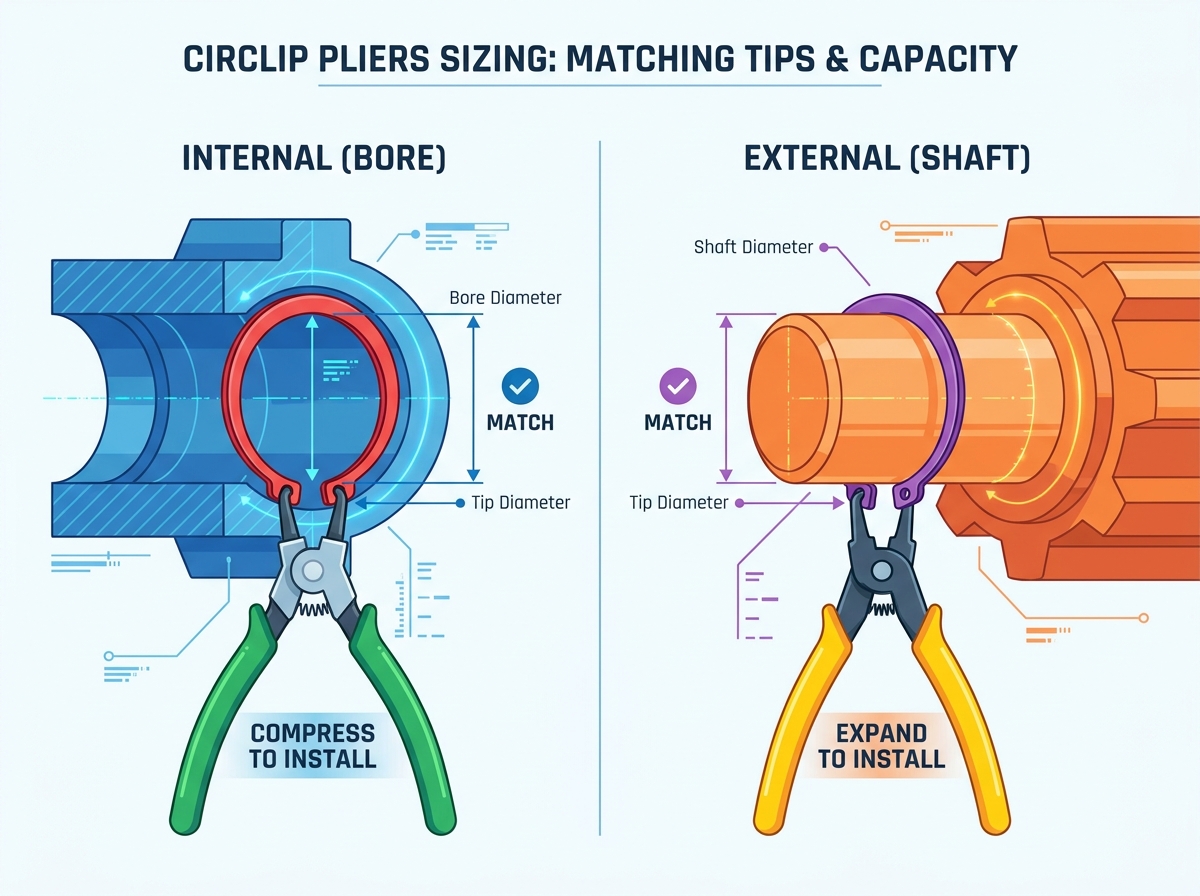
Working inside a confined housing presents unique mechanical and visual challenges. Your primary business problem involves compressing retaining rings safely inside deep cylinder bores. You must perform this action without marring the internal bore wall. Furthermore, you cannot lose control of the aggressive spring tension. Specialized internal circlip pliers address these exact success criteria perfectly. They compress inward seamlessly when you squeeze the handles together.
You must size your tool directly to the specific bore diameter you are servicing. Tool manufacturers divide internal capacities into distinct, well-defined operational brackets. Light-duty models typically cover 8mm to 13mm bore sizes. Mid-range tools routinely handle 12mm to 25mm dimensions in automotive applications. Heavy-duty industrial tasks require robust tools covering 19mm to 60mm ranges. Selecting a tool from the wrong capacity bracket guarantees extremely poor mechanical leverage.
Implementation risks increase significantly when operators misjudge these critical dimensions. Imagine using an undersized tool on a massive internal transmission ring. The internal spring tension easily overpowers weak, undersized plier jaws. The tips might cross over each other under extreme hand pressure. In worst-case scenarios, the tips snap off completely and fall into the machinery. We strongly advise stepping up one size class if you operate near a tool's maximum rated capacity.
External fasteners require an entirely different mechanical approach and physical geometry. You must expand these rings carefully over a solid cylindrical shaft. The primary success criterion is avoiding permanent deformation of the metal. Over-expanding a clip completely destroys its innate elasticity and holding power. A deformed ring will never seat securely inside its machined retaining groove. Proper tool sizing mitigates this costly and dangerous operational error.
Quality external circlip pliers match specific shaft diameters precisely. Similar to internal models, they follow distinct external capacity brackets. Small electronics often require a delicate 3mm to 10mm range. Automotive repairs generally demand a sturdy 10mm to 25mm working capacity. Heavy machinery shafts necessitate robust 19mm to 60mm expansion capabilities. Using too large a tool on a tiny shaft guarantees clumsy handling and potential component scratching.
Professional-grade external tools incorporate specialized over-expansion stop mechanisms. Operators easily stretch clips beyond their elastic limit during fast-paced assembly installations. Adjustable stop screws eliminate this very common human error entirely. You calibrate the set screw to halt jaw movement at a specific maximum width. They physically prevent the handles from opening any further. This brilliant feature ensures every installation perfectly maintains the ring's factory spring tension.
Mechanics constantly debate between buying dedicated tools or highly versatile kits. Each category solves distinct operational problems on the shop floor. Let us examine the versatility approach versus the pure reliability approach. Evaluating these options requires understanding your daily operational tempo and torque requirements.
Interchangeable or universal pliers prioritize ultimate utility and storage efficiency. They feature removable tips in various angles and specific diameters. These kits prove highly cost-effective for low-volume, unpredictable maintenance routines. Unpredictable facility maintenance benefits from having multiple geometric options nearby. However, they carry significant structural and mechanical risks. The removable tips remain highly prone to flexing under high torque. They occasionally break when managing heavy-duty, high-tension fasteners. Alignment issues frequently develop over time due to wear in the locking mechanism.
Fixed-tip pliers represent the ultimate reliability approach for professional technicians. Manufacturers forge them as a single continuous piece of high-carbon steel. They exhibit zero mechanical play during delicate or heavy operations. They transfer maximum gripping force safely directly to the fastener. The primary drawback involves higher initial procurement costs for your toolboxes. You must purchase dedicated sets to cover various sizes, angles, and capacities.
We highly recommend fixed tips for demanding production environments. Heavy equipment maintenance and automotive transmission rebuilds require absolute maximum rigidity. Relegate interchangeable sets strictly to light-duty, occasional applications. They serve quite well in DIY environments or emergency roadside toolkits.
Feature | Interchangeable Tip Pliers | Fixed Tip Pliers |
|---|---|---|
Structural Rigidity | Moderate; prone to slight flexing. | Excellent; forged single-piece steel. |
Cost Efficiency | High for multi-size requirements. | Lower; requires buying multiple tools. |
High-Torque Safety | Low; tips can loosen or snap. | High; zero mechanical play. |
Best Application | Light-duty, occasional DIY maintenance. | Heavy machinery, production environments. |
Accessing the fastener often dictates your tool selection just as much as size does. Straight tips remain the undisputed standard for all direct-access applications. They offer the highest possible force transfer from your hands to the ring. Your hands align perfectly parallel to the main shaft or bore. Whenever possible, we strongly recommend reaching for a straight-tipped tool first.
Obstructed clearances demand entirely different tool geometries and approaches. Deep cylinder bores often block straight access completely. Recessed automotive transmission shafts present similar, frustrating logistical hurdles. In these restrictive scenarios, you must specify 45-degree or 90-degree angled tips. They allow you to maintain a secure 90-degree seating engagement against the ring itself. A proper seating angle prevents the fastener from slipping unexpectedly under load.
You must acknowledge a critical sizing caveat regarding angled configurations. Bending the steel tip inherently introduces a severe stress riser into the metal. Angled tips experience vastly higher stress at the bend during firm compression. Selecting a slightly heavier-duty plier size is highly recommended here to prevent snapping.
Follow these sequential best practices for utilizing angled tools safely:
Verify the exact depth of the obstructed mechanical clearance using a probe.
Select a 45-degree tool if partial diagonal access exists within the housing.
Choose a 90-degree tool strictly for perpendicular access requirements deep inside bores.
Upgrade the tool's capacity rating by one step to offset heavy bending stresses.
Apply hand force slowly to actively monitor for any dangerous tip deflection.
Building an effective toolkit requires strategic planning and specific metric evaluation. Start by identifying your facility's exact range of daily operations. Audit the most common shaft and bore sizes you encounter regularly. Document the lug hole diameters on your most frequently replaced mechanical fasteners. This simple data forms the rock-solid foundation of your purchasing logic.
We strongly advise assembling a reliable minimum viable kit first. Procure a standard four-piece or eight-piece fixed-tip set immediately. Ensure this selected set covers the most critical mid-range dimensions. Look for tips spanning 0.038" to 0.070" in outer diameter. Your kit must include both straight and 90-degree geometric configurations. Naturally, you need both internal and external operational types. This foundational setup easily handles roughly eighty percent of typical mechanical tasks.
Heavy-duty additions become absolutely necessary for massive industrial and agricultural applications. Standard hand-squeeze tools become dangerous on rings exceeding two inches (50mm). Procure specialized ratcheting pliers for handling these massive, high-tension components. Ratcheting mechanisms lock the jaws securely at various stages of expansion or compression. They safely manage massive spring tension while you maneuver the fastener into position.
Finally, enforce strict material verification during your shortlisting process. Never accept cheap stamped metal construction for professional applications. Ensure your shortlisted tools specify hardened, cold-forged steel tips. Cold forging beautifully aligns the metal's grain structure for vastly superior strength. Hardening prevents the tips from rounding off after repeated heavy industrial usage.
Matching the exact tool size permanently prevents damaged parts and dangerous workplace accidents. You must strictly align the tip diameter with the ring's delicate lug hole. Simultaneously, match the jaw capacity accurately to the underlying shaft or bore size. Ignore either crucial metric, and mechanical failure remains inevitable during reassembly.
We urge all professionals to prioritize exact-fit, fixed-tip pliers for daily operations. Treat these implements as calibrated precision instruments rather than generic gripping tools. They ensure maximum efficiency and uncompromised safety during complex, heavy-duty maintenance.
Review your current equipment specifications immediately to identify glaring capability gaps. Measure your most common facility fasteners using a reliable digital caliper. Browse a curated selection of professional plier sets to upgrade your toolkit today safely.
A: Use a digital caliper to measure the diameter of the holes on the snap ring carefully. This dictates your necessary tip size. Next, measure the exact diameter of the shaft or bore. This measurement determines the required jaw capacity bracket for your tool.
A: No. Internal pliers compress to close; external pliers compress to open. Using the wrong type is mechanically impossible for proper seating. Attempting to force it poses a severe safety hazard due to unexpected ring slippage.
A: This usually indicates you are using undersized pliers for the ring's high tension. It also frequently happens when using cheap, un-hardened interchangeable tips on heavy-duty industrial applications. Always upgrade to hardened, fixed-tip tools for stiff rings.
A: Generally, yes. The fundamental mechanics remain identical across measurement systems. Provided the tip diameter accurately fits snugly into the lug holes without excessive play, the tool will function perfectly regardless of its original measurement designation.