- All
- Product Name
- Product Keyword
- Product Model
- Product Summary
- Product Description
- Multi Field Search

Views: 0 Author: Site Editor Publish Time: 2026-08-24 Origin: Site


Every swing on a job site transfers kinetic energy. When that energy meets resistance, it either dissipates through the tool or travels straight up your arm. Framing walls, tearing out old drywall, and setting concrete forms demand thousands of strikes per shift. You have to weigh the frustration of a broken handle against the physical toll of repetitive impact. A missed strike—an overstrike—can snap a traditional handle in half, stopping your workflow dead. But tools built to survive heavy abuse often lack the shock absorption needed to protect your elbow and wrist. A rigid tool survives the demolition, but it punishes the user. We need to look at the primary structural categories: solid forged steel versus assembled multi-material designs. Picking the right setup depends on your daily strike volume, the specific application, and your maintenance habits.
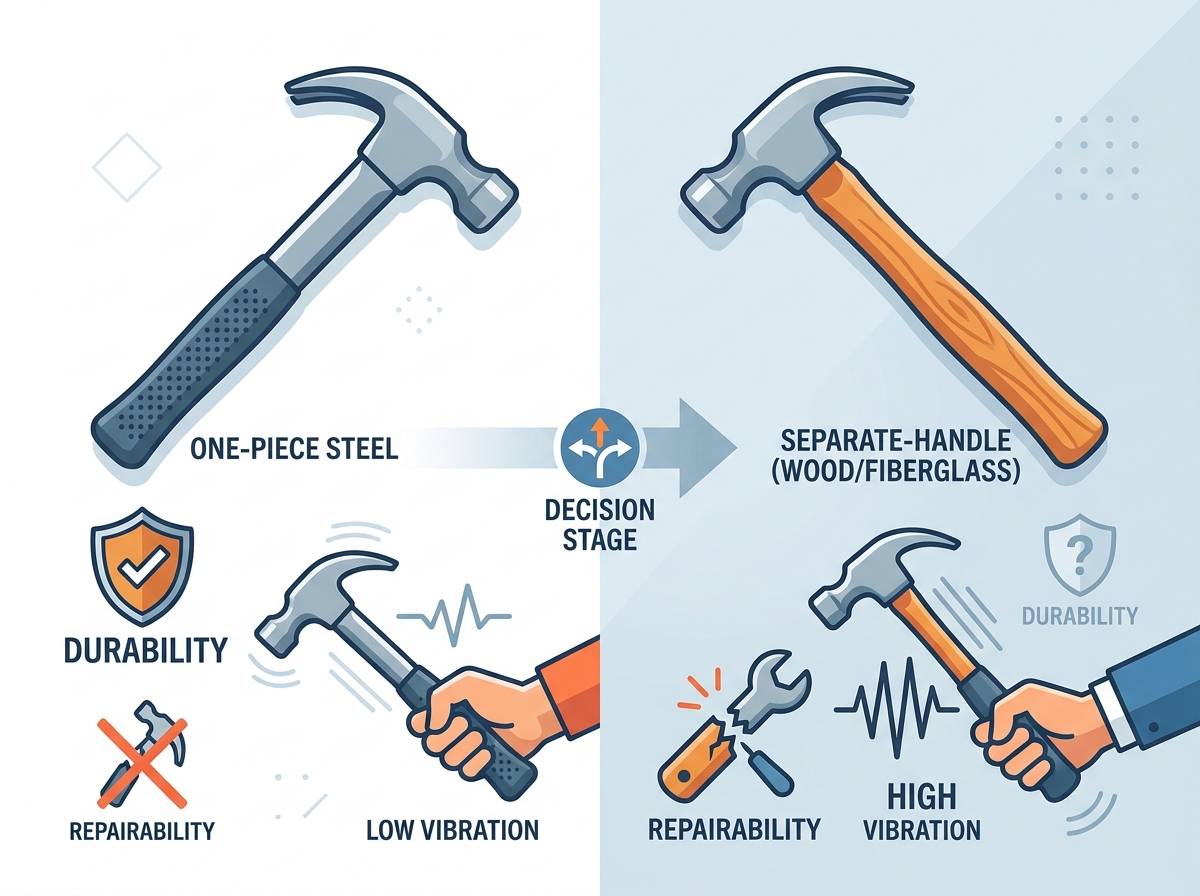
Maximum Structural Integrity: Forged one-piece steel designs eliminate the critical failure point at the head-to-handle junction, offering unmatched survival against overstrikes.
The Vibration Trade-off: Steel naturally transfers more shock to the user's elbow than composite materials; mitigating this requires engineered grips (e.g., urethane plugs or tuning forks) and proper swing technique.
Repairability vs. Replacement: Separate-handle designs allow for field repairs and custom handle fitting, whereas a damaged one-piece hammer typically requires full replacement.
Application-Specific ROI: High-impact, demolition, and rough framing favor solid steel, while high-volume, repetitive striking often justifies the shock absorption and lighter swing weight of separate-handle models.
Understanding what makes a claw hammer different requires looking closely at its anatomical structure. Standard components dictate how the tool performs under heavy stress. The face strikes the fastener, and you can choose between a milled face for gripping framing nails or a smooth face to avoid marring finish work. The cheek provides side mass for balance. The neck connects the head to the handle. The claw extracts fasteners or pries materials apart. These elements work together to deliver force and leverage on the job site.
Traditional designs rely on an "eye." The eye is a hole forged directly into the center of the head. The handle is driven into this eye and secured with wooden wedges and metal roll pins to create a tight friction fit. While effective for centuries, the head-to-handle junction creates a natural weak point. When you pull back on the handle to pry a stubborn 16d sinker out of a wet stud, immense leverage concentrates directly at the eye. Over time, this stress compresses the handle material, causing the head to loosen and wobble.
Solid steel models bypass the eye entirely. Manufacturers use a drop-forging process to create the tool. A single billet of high-carbon steel is heated to extreme temperatures and pounded into shape by massive dies. The head, neck, and shaft become one continuous piece of metal. There is no junction. There are no wedges to fail. This continuous grain structure eliminates the traditional weak point, allowing the tool to handle extreme leverage without separating.
Claw profiles also differentiate these tools based on their intended application. Curved claws feature a thick, sweeping profile. They provide excellent rolling leverage for pulling nails without damaging the surrounding wood surface. Straight claws, often called rip claws, feature a thinner, flatter profile. They are designed to drive easily between joined materials. You can wedge a straight claw between two studs and twist to pry them apart during heavy demolition.
You evaluate a striking tool by how it handles the worst conditions on site. We look at specific metrics to determine if a tool will survive a rough framing environment or if it belongs in a finish carpenter's pouch.
Evaluation Metric | Definition | Job Site Impact |
|---|---|---|
Overstrike Survival Rate | The ability to withstand direct impacts on the neck. | Prevents catastrophic handle failure during missed swings on concrete or steel. |
Shock Dissipation | How efficiently the handle absorbs kinetic energy. | Reduces cumulative trauma and elbow fatigue during high-volume nailing. |
Swing Weight Distribution | The balance point between the head and the handle. | Dictates swing speed, accuracy, and shoulder strain over a ten-hour shift. |
Leverage Capacity | The maximum prying force the neck can handle before bending. | Determines effectiveness in heavy demolition tasks and board bending. |
When you pick up a one-piece steel claw hammer, you immediately notice the rigidity. It feels indestructible because, for most job site applications, it is. This durability stems directly from advanced material science and precise heat treatment. Steel cannot be uniformly hard. If the entire tool were hardened to the same degree, it would become brittle and shatter upon impact like glass. Manufacturers use differential heat treatment to solve this engineering challenge.
The face and the claws are hardened extensively. This prevents the face from mushrooming after striking thousands of hardened steel concrete nails. It also keeps the claws sharp and wear-resistant for digging into wood to grab buried nail heads. The neck and shaft, however, are tempered differently. They are left slightly softer to retain flexibility. This tempering allows the shaft to absorb heavy impacts without snapping under the strain.
This construction eliminates the overstrike penalty. An overstrike occurs when you miss the nail head and strike the material with the neck of the tool. Hitting a concrete form or a metal joist hanger with a wooden neck often results in instant splintering. A solid steel shaft simply bounces off. It survives missed strikes that would destroy assembled tools in a single blow. This makes it highly reliable for heavy construction where accuracy sometimes takes a back seat to speed.
Prying and leverage capacity also increase dramatically with solid steel. Extracting a deeply embedded framing nail requires immense force. When using a thin, straight claw profile for heavy demolition, you can apply maximum body weight to the handle. A continuous steel shaft handles this stress effortlessly. You can pry apart framing lumber, lift floorboards, or twist apart pallets without fearing that the neck will snap under pressure.
Modern solid steel designs also incorporate integrated shaft features. Manufacturers often forge measurement markings directly into the side of the shaft. You might find 200mm or 250mm indicators stamped into the steel. These markings allow for quick layout work. You can space studs or position brackets without reaching for a tape measure. Because the markings are forged into the metal, they never wear off, even after years of sliding in and out of a leather tool belt.
However, solid steel construction introduces weight distribution realities. Steel is dense. A continuous steel shaft adds significant weight below the head. This makes the tool feel top-heavy or generally heavier overall compared to composite alternatives. Users must exert more energy to arrest the swing and lift the tool back to the starting position. This weight penalty requires strong wrists and proper swinging mechanics to manage effectively over a long shift.
While solid steel offers invincibility, assembled tools prioritize user comfort and swing dynamics. The traditional wood handle claw hammer remains a staple on job sites for very specific reasons. Hickory is the industry standard for these tools. It possesses unique material properties that synthetic materials struggle to replicate. The long, linear grain structure of hickory provides natural shock absorption. It flexes slightly upon impact, soaking up kinetic energy before it reaches your hand.
Wood also offers unmatched customization. Professional carpenters often modify their tools to fit their specific grip style. You can shave down a hickory shaft with a rasp to fit your hand perfectly. You can sand the factory varnish off and rub it with boiled linseed oil to improve grip when your hands sweat. You can thin the neck to increase flexibility and whip during the swing. This level of personalization is impossible with steel or synthetic materials.
For those seeking a middle ground between wood and steel, the fiberglass handle claw hammer provides a modern alternative. The core construction relies on pultruded fiberglass. Thousands of glass fibers are pulled through a resin bath and cured into a dense, rigid rod. This core is then wrapped in a polymer or rubber overmold to provide grip and protect the fibers from impact damage.
Fiberglass significantly reduces swing fatigue. It is much lighter than solid steel. This lighter overall weight makes it easier on the hands and reduces shoulder strain during extended use. You can swing a fiberglass tool faster, generating high head speed with less physical effort. It also offers excellent environmental resistance. Unlike wood, fiberglass is immune to moisture. It will not shrink in dry heat or swell in high humidity, which helps keep the head seated tightly.
Despite these advantages, separate-handle designs share a common vulnerability: the assembly itself. The mechanical reality of securing a metal head to a non-metal shaft involves compromises. Wedges, epoxies, and roll pins degrade over time. Every strike creates micro-movements inside the eye. Over months of heavy use, wood compresses and epoxy cracks. The head eventually loosens. Once a head becomes loose, the tool becomes dangerous and requires immediate repair or replacement.
Evaluating durability requires looking at tensile strength and wear resistance. Tensile strength dictates the sheer force required to snap the neck. Solid forged steel wins this category effortlessly. Bending a tempered steel shaft requires mechanical intervention or extreme, unintended abuse. Hickory shafts can snap under heavy prying loads or severe overstrikes. Fiberglass cores offer higher tensile strength than wood but will eventually fracture if subjected to repeated direct impacts on the neck.
Wear resistance depends heavily on environmental factors. Solid steel is highly durable but susceptible to rust if left in wet conditions. The polished face and claws require occasional oiling to prevent corrosion. Wood handles degrade rapidly if exposed to constant moisture or left out in the rain. The grain raises, and rot can set in. Fiberglass handles resist moisture perfectly but suffer from UV degradation. Leaving a fiberglass tool in the bed of a truck in direct sunlight for months will cause the rubber overmold to crack and peel.
The physics of impact govern how a tool feels in your hand. When the steel face strikes a nail, kinetic energy travels rapidly down the shaft. Wood and fiberglass disrupt this energy wave. The cellular structure of wood and the resin matrix of fiberglass absorb the vibrations. Rigid steel shafts do not absorb energy well. They act as a conduit, transferring the majority of the shock directly into the user's hand, wrist, and elbow.
This shock transfer has serious joint health implications. Professional framers swinging solid steel tools all day often develop cumulative trauma disorders. Epicondylitis, commonly known as tennis elbow, is a frequent complaint. The constant, high-frequency vibration inflames the tendons in the forearm. Over years of work, this can lead to chronic pain and reduced grip strength.
Manufacturers recognize this flaw and have developed engineered mitigation strategies for steel tools. Modern solid steel designs rarely feature bare metal handles. They utilize vibration-damping urethane plugs inserted into the core of the grip. Some designs feature a tuning-fork handle structure that splits the steel shaft to disrupt the vibration wave. Specialized rubber grips are molded with air pockets to artificially replicate the shock absorption of wood.
Proper handling and swing technique also play a massive role in mitigating shock. Gripping the handle too tightly transmits maximum vibration into your arm. Utilizing a loose, fluid swing allows the tool to do the work. You should grip the tool firmly enough to control it, but loosely enough to let the handle pivot slightly upon impact. This technique naturally mitigates the shock transfer inherent to rigid steel shafts.
Tools break. How you handle that breakage defines the tool's repairability. Field repair realities differ wildly between materials. Re-handling a wood tool is a standard job site skill that saves money and keeps a favored tool head in rotation. You can perform this repair on the tailgate of a truck with basic hand tools.
Cut off the remaining splintered wood flush with the bottom of the steel head using a handsaw.
Drill out the compressed wood core from the eye using a 3/8-inch bit to relieve the pressure.
Punch out the remaining wood and metal wedges with a drift pin and a heavy mallet.
Seat the new hickory handle by tapping the base until the eye is fully seated on the shoulder of the wood.
Drive the wooden wedge into the top kerf, followed by the metal cross-wedge to lock the assembly tight.
Repairing a solid steel tool is virtually impossible. If you manage to bend the steel shaft by prying something too heavy, the tool is ruined. You cannot bend tempered steel back into perfect alignment without compromising its structural integrity. A bent steel shaft requires a full replacement of the entire tool.
Grip degradation is another factor for steel tools. The rubber or leather grips on one-piece steel models wear out over time. Rubber tears from abrasion against tool belts, and leather smooths out and loses traction. Options for restoring these grips are limited. You can apply aftermarket grip tape, but it rarely matches the comfort of the factory grip. Once the grip is completely destroyed, many users simply discard the tool.
Selecting a striking tool involves assessing initial costs versus lifetime value. Premium one-piece steel models require a higher upfront investment. The complex drop-forging process and specialized grips increase manufacturing expenses. However, this initial investment often translates to a lower lifetime cost for heavy users. You buy a solid steel tool once. You may replace a broken wood or fiberglass handle three times a year if you frequently perform demolition work.
You must also calculate the hidden cost of fatigue. Framing ROI around user fatigue changes the perspective. A heavier, high-vibration steel tool may never break, saving you replacement costs. However, if that vibration causes elbow pain that slows down your swing speed by the afternoon, your daily productivity drops. If the cumulative trauma leads to medical downtime, the indestructible tool suddenly becomes a massive liability. Balancing durability with ergonomics keeps you working longer and faster.
Scalability for crews requires evaluating abuse tolerance. If you are supplying tools for a rough framing or concrete formwork crew, solid steel makes the most sense. These environments are brutal on equipment, and the tools will be used for heavy prying, chipping concrete, and demolition. If you are supplying a finish carpentry or siding crew, separate-handle designs are better. The work requires high-volume, repetitive striking with less need for extreme prying leverage. The lighter weight and better shock absorption will keep the crew moving faster without burning out their arms.
No single striking tool defies the laws of physics. The choice remains a strict trade-off between indestructible construction and optimal shock dissipation. You cannot have maximum prying strength and maximum vibration absorption in the same material. Understanding your specific workflow is the only way to choose the correct configuration for your tool belt.
Use this shortlisting logic to guide your decision. Recommend a solid steel design for heavy framing, demolition, and users with a history of breaking handles. The durability will outlast the abuse. Recommend a fiberglass design for general-purpose utility where weather resistance, lighter swing weight, and moderate shock absorption are needed. Recommend a wood design for high-volume, repetitive striking where joint preservation is the highest priority.
Take these next steps to finalize your setup:
Track your daily strike volume for a week to determine your baseline shock absorption needs.
Audit your current tool graveyard to identify if overstrikes or loose heads cause the most failures.
Test swing different handle materials at the end of a shift when your arm is already fatigued to gauge true comfort.
Select a straight rip claw profile if your daily tasks involve more demolition and prying than driving fasteners.
A: It can. Solid steel transfers more kinetic energy and vibration to your arm than wood or fiberglass. Over time, this high-frequency vibration contributes to cumulative trauma disorders like tennis elbow. Modern designs use urethane plugs and specialized grips to reduce this shock, but proper swing technique remains essential.
A: Replacing the factory-molded rubber grip is generally not possible. Once the grip tears or wears down to the steel core, users typically wrap the handle in heavy-duty grip tape or athletic tape. If the grip is completely destroyed, the entire tool usually needs to be replaced.
A: Professional framers prefer wood, specifically hickory, because it offers superior natural shock absorption. Driving large framing nails all day generates massive vibration. Wood flexes and absorbs this energy, protecting the framer's elbow and wrist. Wood handles can also be customized and sanded for a personalized grip.
A: Yes, a pultruded fiberglass core generally has higher tensile strength than a standard wood handle. It can withstand more prying force and is less likely to snap from a severe overstrike. Fiberglass is also immune to moisture, preventing the shrinking and swelling that can weaken wood handles.
A: A vibration-damping plug is an engineered insert, often made of urethane or specialized rubber, placed inside the core or neck of a solid steel tool. It is designed to disrupt the wave of kinetic energy traveling down the steel shaft, artificially reducing the shock transferred to the user's hand.
A: A longer handle increases the radius of your swing. This allows the head to travel faster, generating more kinetic energy and striking force upon impact. However, longer handles require more control and accuracy, increasing the risk of overstrikes if the user is fatigued.
A: Thin, straight claws are vastly superior for demolition. Their flat profile allows them to be driven easily between joined materials, like studs or floorboards, acting as a wedge. Curved claws are too thick and sweeping to fit into tight spaces, making them better suited for pulling nails.