- All
- Product Name
- Product Keyword
- Product Model
- Product Summary
- Product Description
- Multi Field Search

Views: 0 Author: Site Editor Publish Time: 2026-10-22 Origin: Site


Selecting the wrong teeth per inch ruins woodworking projects fast. It leads directly to severe wood tear-out, binding blades, and wasted physical effort. For professionals and serious hobbyists, matching tooth count and geometry to the wood grain remains a critical pre-purchase decision. Buyers often struggle balancing sheer cutting speed against final finish quality. They stare at tool walls, entirely unsure how to evaluate a new saw properly. Choosing blindly usually means dealing with ruined edges or exhausting workloads at the bench.
We will explore how different cuts demand specific tooth configurations. You will learn to navigate these technical specifications confidently. This article provides a comprehensive, evidence-based framework for selecting the exact TPI needed for crosscuts, rip cuts, and specific wood densities. You can then ensure a confident, correct purchasing decision every time.
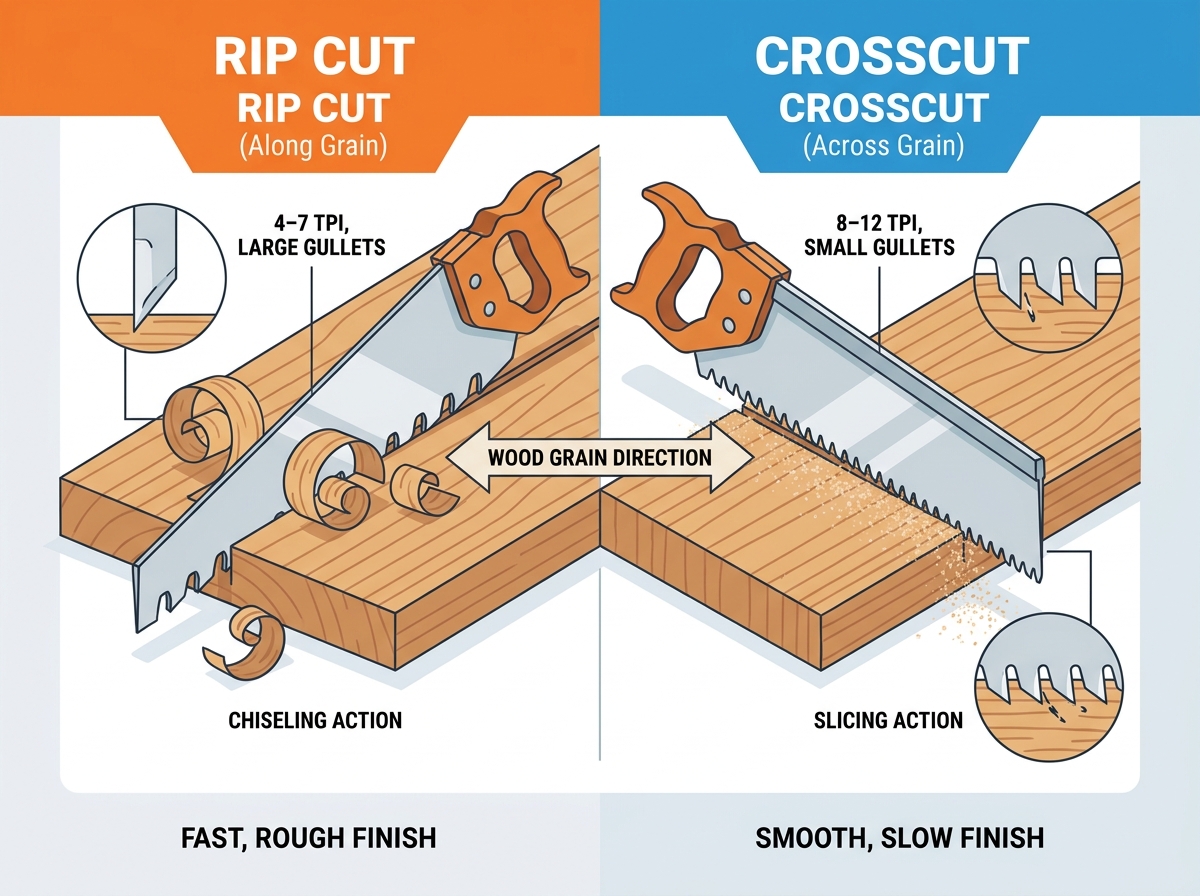
Rip cuts (with the grain) require fewer teeth (typically 4–7 TPI) with deep gullets to aggressively chisel out waste and prevent clogging.
Crosscuts (across the grain) require higher teeth counts (typically 8–12 TPI) shaped like knives to sever wood fibers cleanly and minimize tear-out.
Material thickness dictates minimum TPI: Follow the "Rule of Three"—ensure at least three teeth are engaged in the wood's thickness at any given time to prevent snagging.
Hardwood vs. Softwood: Hardwoods generally benefit from a slightly higher TPI within the recommended range to maintain control and reduce fiber splintering.
More teeth do not simply mean a "better" cut. Many beginners make this incorrect assumption. They buy the finest tooth blade available. They then wonder why their tool stalls halfway through a board. hand saw TPI directly controls the size of the gullet. The gullet is the empty valley space between each tooth. This space plays a mandatory role in removing sawdust.
You must evaluate gullet capacity before making a cut. Low TPI equals large gullets. You need large gullets for clearing long, stringy shavings. These shavings generate rapidly during rip cuts. High TPI equals small gullets. Small gullets are ideal for carrying away fine dust. You generate this fine dust during precision crosscuts.
Every woodworker faces a constant speed versus smoothness trade-off. A lower TPI cuts significantly faster. It removes material in large chunks. However, it leaves a rougher surface behind. You will need more post-cut planing or sanding to fix it. Conversely, a higher TPI yields a much smoother finish. The smaller teeth leave fewer aggressive scratches. The downside is increased time and physical exertion. You must push the blade many more times to achieve the same depth.
Table 1: TPI Configuration and Performance Outcomes
TPI Range | Gullet Size | Cut Speed | Surface Finish Quality | Primary Application |
|---|---|---|---|---|
4 - 7 TPI | Large / Deep | Very Fast | Rough / Splintered | Ripping, rough sizing |
8 - 11 TPI | Medium | Moderate | Clean / Smooth | General crosscutting |
12 - 16+ TPI | Small / Shallow | Slow | Very Fine / Flawless | Joinery, veneer work |
Tooth count only tells half the story. TPI cannot be evaluated without understanding the shape of the teeth among different hand saw types. Tooth geometry dictates how the blade interacts with wood fibers. Think of wood grain like a tight bundle of drinking straws. Cutting parallel to the straws requires a different approach than cutting across them.
Rip saws cut parallel to the wood grain. Manufacturers file these teeth straight across. We call this a 0-degree fleam angle. The front face of each tooth sits completely flat.
Action: Each tooth acts as a tiny chisel. It plows straight through the wood grain.
Debris: It peels out long, curly ribbons of wood. The deep gullets carry these ribbons away.
Application: They work best for sizing rough lumber along the grain. Do not use them across the grain, or you will tear the fibers severely.
Crosscut saws slice perpendicular to the wood grain. Manufacturers file these teeth at an alternating angle. We call this a 15–20 degree fleam. This creates a sharp bevel on alternating sides of the blade.
Action: The teeth act as alternating knives. They score and sever the horizontal fibers cleanly.
Debris: They produce a fine, granular sawdust. The smaller gullets handle this dust perfectly.
Application: They work best for cutting boards to length. They leave minimal splintering on the exit side of the cut.
Selecting the correct tooth count requires a systematic approach. You must match the aggressiveness of the blade to your specific task. We can break these choices down by cut direction and desired finish.
Ripping lumber requires significant physical effort. The blade travels down the entire length of the board. You want to maximize speed without losing control of the tracking line.
4–5 TPI: This range provides aggressive, rapid stock removal. Use it for thick rough lumber. It easily handles 2-inch thickness or greater. You will save massive amounts of time, though the edge will need jointing later.
6–7 TPI: This is the standard rip sizing configuration. It offers an excellent balance of speed and manageable effort. It works perfectly for 4/4 to 8/4 (1-inch to 2-inch) stock. Most traditional woodworkers prefer 7 TPI for their daily rip tasks.
Crosscutting focuses heavily on surface finish. A ragged crosscut looks terrible. It also ruins tight joinery. You must select a tooth count capable of slicing fibers gently.
7–8 TPI: This range handles coarse crosscutting. Carpenters use it for framing lumber. Finish quality does not matter here. Speed remains the primary goal when framing a wall.
9–11 TPI: This is the general-purpose woodworking sweet spot. It produces clean cuts on standard hardwoods like oak and maple. You will see very minimal tear-out. It balances speed and neatness beautifully.
12–14+ TPI: You need this for fine joinery, veneer, and delicate trim work. These applications require zero tear-out. You will often find these high counts in specialized backsaws and dovetail saws.
Wood density heavily influences blade performance. The Janka hardness scale measures how resistant a wood species is to denting and wear. Pine has a very low Janka rating. Hickory possesses a very high Janka rating. When cutting dense, high-janka-rating hardwoods, lean toward the higher end of the TPI range for that specific cut. Dense fibers resist cutting. A lower tooth count might bite too deeply. This causes the blade to catch, jump, or stall completely. Extra teeth distribute the cutting force more evenly across the hardwood.
Many beginners face a frustrating budget constraint. Space constraints in mobile toolkits also pose a major issue. Carrying multiple full-size hand tools is often entirely impractical. You might wonder if a single blade can do it all.
Historically, carpenters solved this using a hybrid design. Selecting a woodworking hand saw in the 8–9 TPI range offers a decent compromise. Manufacturers file these teeth with a relaxed crosscut profile. We call this a semi-fleam angle. The bevel is less aggressive than a dedicated crosscutter.
You must understand the distinct performance trade-offs of a hybrid setup.
It will crosscut cleanly. However, it will cut slower than a dedicated 12 TPI blade.
It will rip cut down the grain. However, it requires significantly more physical effort than a true 5 TPI rip profile.
The gullets may clog slightly on long rips. You will need to clear the blade frequently.
We recommend this hybrid approach only for specific situations. It works well for low-volume cutting. It also serves as a great entry-level purchase. You can build your foundational skills with it. Later, you should invest in dedicated rip and crosscut tools as your projects become more complex.
Ignoring these principles leads to immediate workshop frustration. The physical mechanics of cutting wood punish incorrect tool choices quickly. You must watch out for three primary implementation risks.
Binding happens when sawdust has nowhere to go. Imagine using a 10 TPI crosscut profile for a long, thick rip cut. You will fill the small gullets with stringy sawdust immediately. The dust packs tightly into the valleys. The blade swells inside the kerf. The steel overheats rapidly. Eventually, the tool binds completely and stops moving. You risk bending the blade if you force it.
Tear-out ruins the backside of your workpiece. Imagine using an aggressive 5 TPI rip profile for a crosscut on thin, brittle material. The large, flat chisel teeth will grab the delicate fibers. Instead of slicing them neatly, the teeth violently rip the fibers away from the board. This ruins the workpiece instantly. You cannot repair a badly torn crosscut edge.
This is the most common beginner mistake. You must always follow the Rule of 3. Ensure at least three teeth span the thickness of the wood at all times. Selecting a TPI so low that fewer than three teeth engage causes severe mechanical issues. The tool will straddle the board. It will drop violently into the cut, bounce back up, and chatter loudly. It will repeatedly jump out of the kerf, potentially damaging your hand. For example, cutting a 1/4-inch thick board requires at least a 12 TPI blade to keep three teeth engaged.
The right tooth count transforms a frustrating chore into a smooth, rewarding process. It is a calculated decision based on cut direction, material thickness, and desired finish quality. Rip cuts demand aggressive chisels and deep gullets. Crosscuts require sharp slicing knives and finer spacing. You must also respect the Rule of 3 to prevent dangerous binding and chatter.
For a standard hand tool shop setup, we recommend a simple two-tool strategy. Prioritize acquiring a 7 TPI Rip saw and a 10 TPI Crosscut saw. Use these as your foundational evaluation baseline. Master their mechanics first. You can then move confidently into purchasing specialized joinery saws for finer tasks.
A: Yes, but it will be highly inefficient. The knifelike teeth and small gullets will clog quickly with long wood fibers. This makes the cut painfully slow. You will expend significantly more physical energy and risk binding the blade inside the kerf.
A: Look down the barrel of the teeth. If they look like flat chisels straight across, it is a rip saw. If they look like alternating sharp needles or knives, it is a crosscut saw. TPI will also be noticeably lower on the rip model.
A: Because plywood consists of alternating grain directions, you must treat every cut as a crosscut. Use a high-TPI saw, ideally between 10 and 14 TPI. This minimizes veneer tear-out on both sides of the cut and provides a clean, manageable edge.