- All
- Product Name
- Product Keyword
- Product Model
- Product Summary
- Product Description
- Multi Field Search

Views: 0 Author: Site Editor Publish Time: 2026-10-10 Origin: Site


A stripped screw halts production instantly. It ruins expensive materials like finished plywood. Worse, it turns a simple 10-second fastening task into a 10-minute extraction process. "Cam-out" happens when a bit slips forcefully from the screw head. Many users immediately blame their own technique. They are usually wrong. Cam-out is almost always a structural mismatch. You might be using the wrong drive profile. Or, you might be utilizing improper tool metallurgy for the torque applied.
This guide provides a precise technical framework. We help you identify exact bit profiles easily. You will learn how to match fasteners to the correct drive size flawlessly. We also explain how to select commercial-grade bit sets. You want sets prioritizing pure torque transfer over flashy coatings. These ineffective coatings often fail quickly under heavy load. Master these principles to eliminate stripped fasteners. You will work faster and protect your workpieces from unnecessary damage.
Stripped screws are primarily caused by using standard Phillips bits on Pozidriv screws (or vice versa) and using incorrect gauge sizing.
Matching screwdriver bit sizes to the exact screw gauge ensures maximum surface contact, effectively eliminating cam-out.
For base materials, S2 tool steel offers a superior balance of hardness and shock resistance compared to standard Cr-V (Chromium-Vanadium).
Investing in a precision-machined ratchet screwdriver bits set reduces the risk of rounding out fasteners during repetitive, high-torque manual applications.
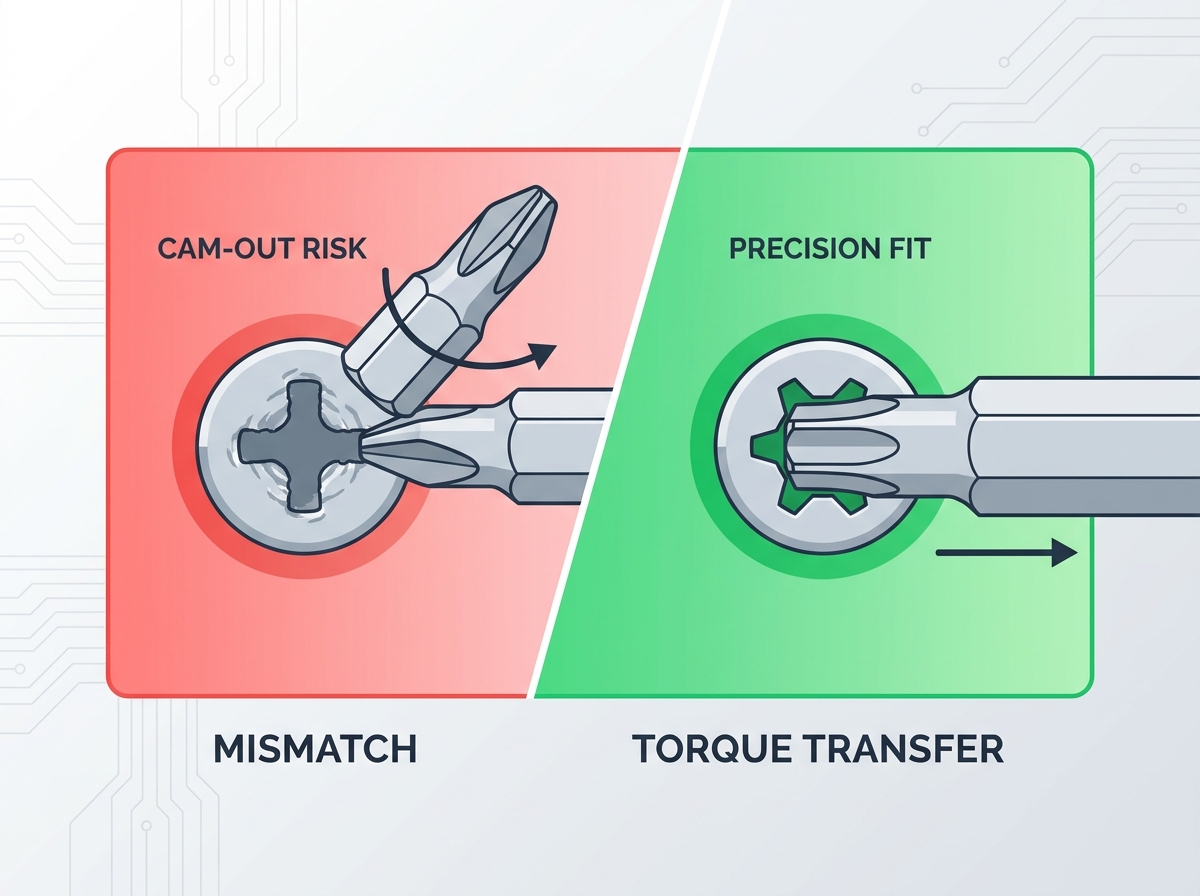
We often hear the term "cam-out" on job sites. It describes the physical action of a tool slipping out of a fastener head. This failure happens when rotational force converts to outward thrust. You apply heavy torque to turn the screw. If the bit angles do not perfectly match the recess, the force redirects upward. The bit lifts out of the drive slot. Continued spinning chews away the metal. Soon, you have a completely rounded, useless screw head.
This poor fit carries heavy consequences. The downstream effects on workpieces can ruin an entire project. A slipping tool easily damages delicate cabinet hinges. It gouges adjacent hardware instantly. If you are driving fasteners into hardwoods, a violent slip causes severe splintering. You then face the added labor cost of extraction. Removing a stripped fastener requires special bits. It demands extra time and stops your workflow completely.
You must understand the core culprit behind this damage. Visually similar bit profiles are incredibly deceiving. They remain the leading cause of fastener degradation. A bit might look like it fits. It might even turn the screw a few times. However, structurally different angles handle torque differently. Microscopic gaps between the tool and the fastener generate friction and heat. Eventually, the structural mismatch forces the tool upward. You cannot overcome a bad fit by pushing harder. You only accelerate the stripping process.
Engineers design different drive architectures for very specific reasons. Recognizing these subtle variations separates amateurs from professionals. Evaluating these shapes helps you select the correct tool every time.
Phillips (PH): Henry Phillips designed this profile intentionally to cam-out. In early automotive assembly, tools lacked torque control. Cam-out prevented workers from over-tightening and breaking fasteners. It remains ideal for older standards. However, it is highly prone to stripping under modern high-torque power tools.
Pozidriv (PZ): This profile solves the Phillips cam-out problem. It features blunt flanks and secondary ribs. You can identify them by the diagonal tick marks engraved on the screw head. Pozidriv does not cam-out easily. It handles higher torque effortlessly. Crossing PH and PZ bits will instantly strip the fastener.
Torx (TX) / Star: This profile offers the absolute highest torque transfer. It features a precise six-point star design. Torx guarantees zero outward thrust. The tool stays securely seated in the recess. It serves as the industry standard for structural and high-load applications.
Robertson (Square): Canadian engineer P.L. Robertson invented this tapered square fit. The slight taper allows for one-handed driving. It wedges securely onto the bit. It is highly resilient to stripping and dominates woodworking markets.
Applying this selection logic requires understanding your application. Map specific screwdriver types to their optimal use cases. Torx dominates deck building and automotive repairs. It handles extreme torque without slipping. Pozidriv excels in European cabinet hardware installation. Phillips handles basic drywall installation perfectly. Robertson shines in general furniture assembly. Choosing the right profile prevents unnecessary wear on both tools and materials.
Understanding the fundamental connection between tool and fastener is vital. The industry standard shank bridges this gap perfectly. Almost all professional insert bits feature a 1/4-inch hex shank. This universal sizing ensures broad compatibility. You can swap them between manual drivers and powerful impact drills easily. This standardization simplifies your tool kit significantly.
However, the tip size dictates your success. You must pair exact screwdriver bit sizes to their corresponding screw gauges. We break down these features-to-outcomes below.
For Phillips and Pozidriv, professionals primarily use sizes 1, 2, and 3. The number 2 size (PH2 or PZ2) acts as the standard for #8 and #10 screws. Using a smaller PH1 on a #8 screw guarantees a rapid strip. The bit rattles loosely in the recess. Conversely, a PH3 will not seat deeply enough into a #8 screw.
Torx requires even stricter matching. You will commonly encounter sizes like T15, T20, and T25. A T20 fits most cabinet screws perfectly. A T25 handles heavier construction fasteners. Slotted bits require careful width and thickness pairing. If the blade is too thin, it bends under torque. If it is too wide, it chews the surrounding material.
Drive Profile | Common Bit Size | Optimal Fastener Gauge / Use Case |
|---|---|---|
Phillips (PH) | PH1 | #4, #5, #6 screws (Small electronics) |
Phillips (PH) | PH2 | #8, #10 screws (Standard drywall, wood) |
Pozidriv (PZ) | PZ2 | Cabinet hinges, particleboard screws |
Torx (TX) | T20 | #8 construction screws, deck boards |
Torx (TX) | T25 | #10 structural screws, automotive framing |
Slotted | 5.5mm / 6.5mm | Electrical faceplates, older hardware |
To guarantee a perfect fit, try the "Wiggle Test" verification method. It offers a highly practical, low-risk implementation step. Simply insert the bit into the fastener before attaching it to the tool. Hold the bit shaft. Lift the screw into the air. A properly sized bit should hold the screw completely horizontally. It achieves this without relying on magnetic force. If the screw droops or wobbles, swap your bit size immediately.
Even the correct bit profile will fail if made from inferior steel. Base metal composition dictates longevity. It separates disposable tools from professional investments. We compare the two most common industry materials.
Cr-V (Chromium-Vanadium) serves as the standard for most basic manual tools. It resists rust well and handles light duty adequately. However, it is fundamentally too soft for modern impact applications. Under high stress, Cr-V experiences rapid bit deformation. The flutes twist and warp permanently.
S2 Tool Steel provides a vastly superior alternative. Manufacturers formulate S2 steel to be highly shock-resistant and deeply hardened. It flexes slightly under extreme loads instead of shattering. It represents the baseline requirement for professional daily use. It outlasts Cr-V exponentially in heavy-duty fastening.
You must also assess bit coatings with evidence-oriented skepticism. Manufacturers love marketing flashy gold tips. Titanium Nitride (TiN) looks incredibly premium on store shelves. Unfortunately, the thin coating often flakes off under high friction. It provides minimal long-term benefit. In contrast, diamond-coated bits offer genuine utility. They feature industrial diamond particles embedded in the tip. This texture provides functional micro-friction. It literally grips the internal walls of partially stripped screws. They cost a premium, but they save compromised fasteners effectively.
Finally, consider the engineering behind torsion zones. High-end impact-rated bits feature narrowed midsections. These torsion zones intentionally twist slightly during fastening. They absorb dangerous peak torque spikes. This flexing protects both the brittle bit tip and the screw head. It prevents catastrophic snapping during sudden stops in hard materials.
Building an efficient toolbox requires strategic selection. You must balance consolidation versus redundancy carefully. Many buyers fall for massive 100-piece kits. They assume more pieces offer better value. In reality, these sets are filled with obscure sizes you will never use. Instead, look for sets heavily weighted with duplicates. You want multiple copies of high-wear sizes like PH2 and T25. When one eventually degrades, you have an immediate replacement ready.
The manual tool driving these bits matters equally. A robust gear mechanism changes how you work. A high-tooth-count gear delivers fine ratcheting action. It reduces hand fatigue over long shifts. Fine gears also help maintain steady, uninterrupted downward pressure. This continuous pressure significantly lowers the risk of manual cam-out. Investing in a quality ratchet screwdriver bits set transforms tedious assembly work.
You must also evaluate the bit retention quality of your chosen set. Check the chuck mechanism or the internal magnetic retention. Cheap sets suffer from excessive bit wobble. We call this "runout" in the industry. Runout creates an unstable, wobbly connection. It acts as a major secondary cause of off-axis stripping. A precision-machined collar holds the bit dead straight.
Take action before your next project. We recommend auditing your current bucket of stripped fasteners. Identify the most commonly abused size causing your headaches. Then, purchase a targeted, S2-steel metric and imperial set. Discard your heavily worn bits immediately to stop future damage.
Stripping screws remains one of the most frustrating aspects of building and repair. However, it is entirely preventable. You must prioritize precise profile matching over sheer physical force. Applying extra weight to a poorly fitted tool guarantees failure. Choosing the right geometry solves the root problem permanently.
We advise standardizing your toolboxes around a reliable, high-grade bit ecosystem. Follow these actionable next steps to ensure pristine fastener results:
Audit your primary bit kit and discard any tips showing rounded flutes or shiny wear marks.
Explicitly separate heavy-duty impact bits from your precision manual bits to prolong tool lifespan.
Match Pozidriv screws strictly with PZ bits, looking for the crucial diagonal tick marks on the head.
Rely on the "Wiggle Test" to confirm correct gauge sizing before applying any manual torque.
A: Most commercial bits utilize a universal 1/4-inch hex shank standard. This design allows seamless swapping between manual bit drivers, ratchets, and power drills. However, precision electronics repair kits use specialized 4mm micro-bits. These smaller bits require dedicated micro-driver handles and will not fit standard 1/4-inch chucks without an adapter.
A: Look closely at the screw head. A standard Phillips (PH) screw has a simple cross recess. A Pozidriv (PZ) screw features four extra diagonal "tick marks" radiating from the center cross. If you see those faint lines, you must use a PZ bit. Mixing them will instantly round out the recess.
A: This indicates a metallurgy mismatch. Bits that are too hard or brittle tend to snap under sudden torque spikes. This often happens when using standard manual bits in heavy-duty impact drivers. Conversely, bits made of cheap steel are too soft, causing them to twist and strip. Always use S2 tool steel for impact applications.
A: Yes, you can safely use impact-rated bits in manual ratchets. They share the same 1/4-inch hex base. However, impact bits often feature narrowed torsion zones. These zones can sometimes sit too deeply in shallow manual chucks, causing slight wobble. Ensure your ratchet has a sufficiently deep collar for a secure fit.