- All
- Product Name
- Product Keyword
- Product Model
- Product Summary
- Product Description
- Multi Field Search

Views: 0 Author: Site Editor Publish Time: 2026-09-23 Origin: Site


High-value power tools, lithium-ion batteries, and precision hand tools represent a massive daily investment. They remain highly vulnerable to rust, short circuits, and severe damage from daily jobsite exposure. Sudden downpours, deep mud, and sitting unprotected in open truck beds will ruin expensive gear quickly.
Unfortunately, marketing terminology is notoriously misleading across the hardware industry. Many bags casually labeled "weatherproof" fail completely in real-world conditions. Capillary action pulls ground moisture straight through standard fabric bases. Furthermore, cheap zippers invite immediate leaks during heavy rain showers.
We need a strict, evidence-based evaluation framework. You must separate a genuine waterproof tool bag from basic water-resistant carriers. This guide provides exact specifications to ensure your gear survives. We examine molded base construction, fabric denier, and storm-sealed zippers. You will learn how to evaluate bags critically and secure reliable protection for extreme outdoor work environments.
Base Construction is Critical: A hard, molded polypropylene base is the only reliable defense against standing water and mud.
Material Matters: Look for PVC-coated fabrics, TPU layers, or 1680D ballistic nylon to ensure water sheds rather than absorbs.
Closure Compromises: An open mouth tool bag offers superior access but requires reinforced, overlapping storm-closures to survive outdoor precipitation.
The Zipper Weak Point: Standard zippers are water entry points; oversized, coated, or flap-protected zippers are mandatory for true weather protection.
Professionals frequently confuse water-resistant fabrics with truly waterproof construction. Manufacturers exploit this confusion by using vague terminology on product tags. Understanding the technical distinction saves you from catastrophic equipment failure.
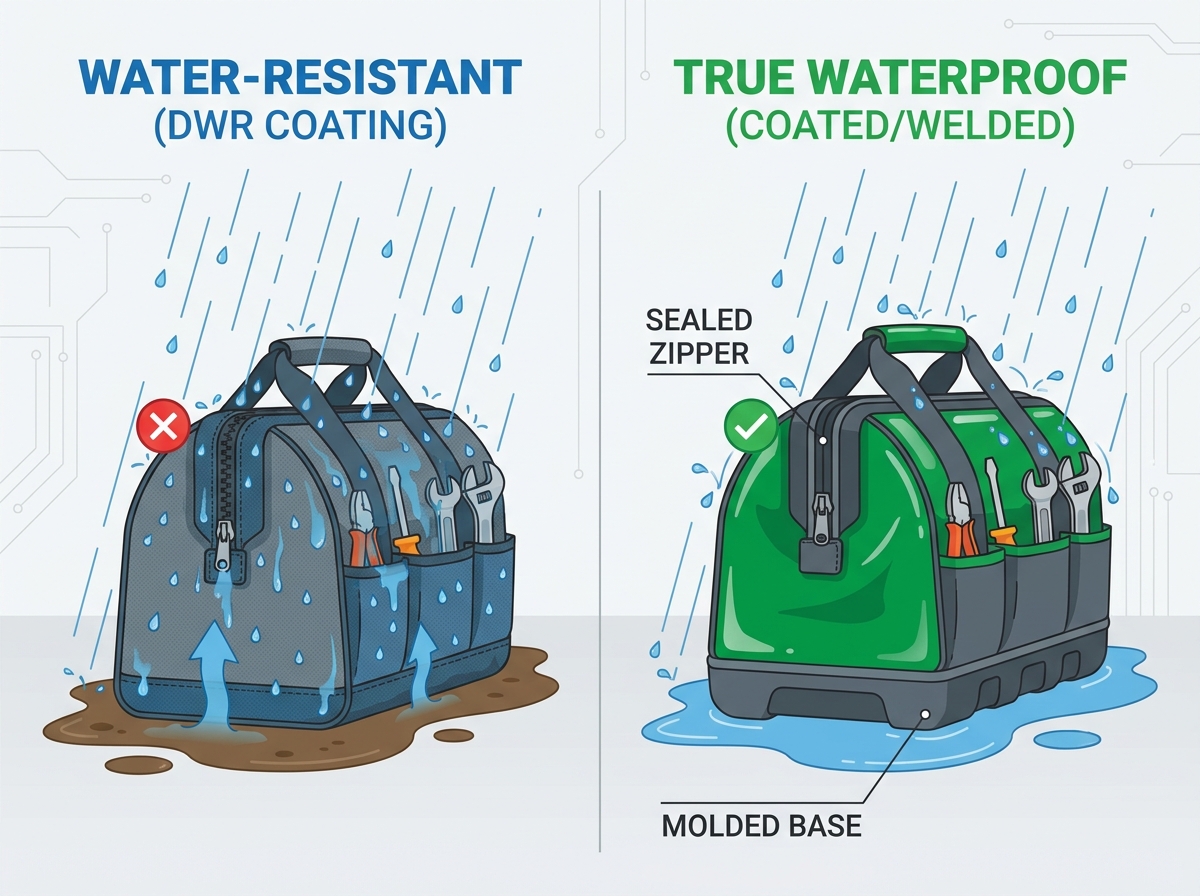
Water-resistant bags rely on Durable Water Repellent (DWR) coatings. Fabric treated this way causes light rain to bead up and roll off the surface. However, this protection fails rapidly under continuous exposure or heavy downpours. Jobsite abrasion easily wears off the chemical DWR coating over time. Dragging the bag across concrete or stuffing it into tight truck boxes strips the protective layer away.
True waterproof construction utilizes entirely different material science. These bags feature PVC, TPU (Thermoplastic Polyurethane), or heavy rubberized coatings. Manufacturers weld the seams together rather than stitching them. A welded seam blocks water entirely because no needle holes exist to let moisture seep through. While this construction provides superior exterior protection, it often lacks breathability. You risk internal condensation if you store damp items inside.
We must also realistically evaluate the term "submersibility" in our industry. Almost no soft-sided bag achieves a true IP67 submersion rating. The standard for a jobsite waterproof rating means surviving an open truck bed during a severe thunderstorm. We expect the bag to repel aggressive directional rain, not survive underwater submersion in a trench.
Jobsite Protection Standards Compared
Feature | Water-Resistant (DWR) | True Waterproof (Coated/Welded) |
|---|---|---|
Primary Defense Mechanism | Chemical surface treatment | Impermeable physical barriers (PVC/TPU) |
Seam Construction | Standard nylon stitching | Heat-welded or heavily taped seams |
Continuous Rain Performance | Fails after 20-30 minutes of exposure | Blocks water indefinitely |
Condensation Risk | Low (fabric remains breathable) | High (traps internal moisture) |
You cannot compromise on foundational structural elements when selecting extreme weather gear. Identifying these four features guarantees your equipment remains safe across unpredictable seasons.
A molded polypropylene base serves as your primary defense against ground moisture. Job sites feature standing puddles, deep mud, and melting snow. A fabric base, even a coated one, eventually succumbs to capillary action. Moisture wicks upward, soaking everything resting at the bottom.
A hard base prevents this wicking entirely. It also keeps the bag standing upright when dropped. Upright posture allows for fast, one-handed access while you hold onto a ladder or work piece. However, you must consider the implementation risk. A thick molded base significantly increases the empty weight of the carrier. You trade lightweight portability for absolute ground protection.
Fabric thickness determines resistance to both water ingress and puncture. Sharp drill bits, saw blades, and dropped screws destroy thin materials quickly. Once a puncture occurs, waterproofing vanishes.
Industry standards demand a minimum of 1680D (denier) ballistic polyester. Alternatively, look for thick canvas backed by an internal PVC or polyurethane layer. The dense weave repels abrasion, while the internal backing stops liquid from penetrating the primary compartment.
Even the thickest waterproof material fails if the zipper leaks. Zippers represent the number one point of water entry. Interlocking metal or plastic teeth naturally leave microscopic gaps for rain to exploit.
You need oversized YKK zippers hidden beneath generous fabric storm flaps. Alternatively, seek out rubberized aqua-guard zippers. These modern zippers feature a polyurethane coating over the tracks. They actively resist mud, freezing rain, and grit jamming. Always check how smoothly these coated zippers operate before purchasing.
A bag becomes useless if its structural rings rust and snap under load. Repeated wet exposure attacks standard steel hardware aggressively.
Marine-grade hardware prevents rust on the bag’s structural components. You should verify D-rings, rivets, and strap clasps utilize stainless steel, brass, or heavily powder-coated alloys. Rust not only weakens the metal but also stains your work clothes and transfers corrosive dust to your pristine tools.
Many tradespeople prefer wide-mouth designs for daily efficiency. An open mouth tool bag provides unmatched visual access to your entire inventory. It effortlessly accommodates bulky items like circular saws or oversized pipe wrenches.
However, this design presents a massive risk if left open during a sudden weather shift. A passing shower turns a wide-open bag into a small swimming pool. You must balance the trade-off between rapid tool access and environmental security. To solve this dilemma, manufacturers developed gate-mouth designs. These bags incorporate rigid internal wire frames surrounding the opening.
When you let go of the handles, the wire frame forces the bag to snap shut instantly. This action immediately protects the interior from sudden rain. You must verify one key feature before buying these designs. Ensure the zipper mechanism allows the bag to close completely. Cheaper models leave distinct "end gaps" where the zipper track terminates. Rain flows directly into these gaps, rendering the rest of the waterproof fabric useless.
Bigger rarely means better when discussing waterproof gear. Professionals often fall into the overpacking trap. Waterproof materials and heavy rubber bases inherently add bulk to the design. A fully loaded 24-inch carrier easily exceeds safe ergonomic lifting limits.
You need efficient portable tool storage rather than a massive, unmovable chest. Carrying fifty pounds of tools on one shoulder across uneven mud leads to severe joint strain. Prioritize a compact footprint and distribute your heavy gear across multiple smaller bags.
Internal moisture management requires strict attention. Storing wet tools inside a highly sealed waterproof bag causes rapid rusting and mildew growth. The same material keeping rain out traps humidity inside. Look for segmented, wipeable internal compartments. Evaluate how the manufacturer handles ventilation strategies.
When assessing carry systems, follow these numbered evaluation steps:
Inspect the strap padding: Shoulder straps must feature closed-cell foam padding. Open-cell foam acts like a sponge, absorbing rain and sweat instantly. Closed-cell foam repels water entirely.
Check the mesh material: Heavy-duty, moisture-wicking mesh should cover the shoulder pads to prevent chafing on hot, humid work days.
Test the attachment points: Ensure the shoulder strap connects to metal D-rings anchored directly into the bag's heavy webbing, not just the outer fabric layer.
Visual inspections often reveal manufacturing shortcuts. Waterproof fabric behaves differently than standard nylon. It feels stiffer and lacks stretch. This rigidity puts significantly more stress on seams when the bag reaches full capacity.
Stitching blowouts remain common in budget options. You must demand double-stitched or Kevlar-reinforced load-bearing points. Single-stitched seams will tear apart under the weight of lithium-ion batteries and heavy wrenches.
Handle detachment causes dangerous jobsite accidents. Handles sewn exclusively into the top fabric layer will eventually rip completely off. Straps must wrap completely under the belly of the bag. Better yet, look for straps riveted directly into the hard molded base. This transfers the lifting force away from the weaker fabric.
Finally, read the warranty fine print carefully. Many manufacturers advertise lifetime warranties against material defects. However, warranty exclusions are standard practice. Almost zero brands will cover the cost of ruined tools inside if the bag fails. They replace the fifty-dollar bag but ignore the thousand dollars worth of water-damaged electronics. You carry the ultimate risk, which highlights why upfront inspection remains vital.
Common Mistake: Ignoring zipper maintenance. Mud and drywall dust act like sandpaper against waterproof zipper coatings.
Best Practice: Brush out the zipper tracks weekly and apply a silicone-based zipper lubricant to maintain the water-tight seal.
Securing reliable gear protection requires looking past clever marketing buzzwords. Use strict shortlisting logic to evaluate every purchase. Prioritize a molded base first to defeat ground water. Next, verify material thickness and welded construction. Finally, scrutinize zipper quality and overlapping storm flaps.
Your next step involves auditing your daily tool load and assessing your primary climate. Select a compact 14-inch to 16-inch model for sensitive diagnostic meters and hand tools. This size encourages easy carry and prevents dangerous overloading. Reserve large, rolling waterproof totes strictly for heavy power tools and bulk materials. By matching the right waterproof technology to your exact loadout, you guarantee your essential equipment remains dry, rust-free, and ready for work.
A: No. Most are designed to repel heavy rain and standing water from the bottom up. While the base blocks deep puddles, water will eventually penetrate zippers and seams if fully submerged. Do not treat soft-sided gear like hard IP67 cases.
A: Hose down the plastic base and wipe the fabric with a damp cloth and mild soap. Never machine wash the bag. Harsh laundry detergents strip away durable water repellent (DWR) coatings and weaken heat-welded seams.
A: Always dry tools thoroughly before storing them. Because sealed bags trap interior humidity, you must manage inevitable moisture. Keep silica gel desiccant packs inside the main compartment or use a rust-inhibiting tool liner to protect sensitive metals.