- All
- Product Name
- Product Keyword
- Product Model
- Product Summary
- Product Description
- Multi Field Search

Views: 0 Author: Site Editor Publish Time: 2026-08-31 Origin: Site


Repetitive striking takes a massive physical toll on your body. High-volume hammering transfers kinetic shock directly into your wrists, elbows, and shoulders. These repeated micro-traumas add up fast over a long shift. Standard solid-shaft hammers transmit unabsorbed kinetic energy straight into your arm. This recoil causes rapid muscle fatigue and wrecks your striking accuracy. Over time, it frequently leads to severe musculoskeletal injuries like epicondylitis. Engineered anti-vibration technology offers a structural fix to this widespread ergonomic problem. It mitigates shock transfer effectively before it reaches your hand. By absorbing these harsh impacts, an anti-vibration claw hammer allows you to maintain sustained striking control. It maximizes energy efficiency and significantly reduces injury risk on the job site. You get more driving power with less physical wear and tear.
Vibration reduction relies on specific material science (fiberglass, titanium, specialized polymers) and structural engineering (tuning-fork handles, dampening collars), not just superficial rubber grips.
Minimizing shock transfer directly correlates with improved striking control and driving efficiency, as reduced hand fatigue allows for more consistent swing mechanics over a full workday.
Solid steel shafts inherently transmit more shock than composite or multi-piece designs; evaluating the underlying shaft construction is critical to verifying "anti-vibe" claims.
Choosing the right claw hammer requires balancing swing weight, durability, and shock-absorption capabilities based on the specific demands of framing versus finish work.
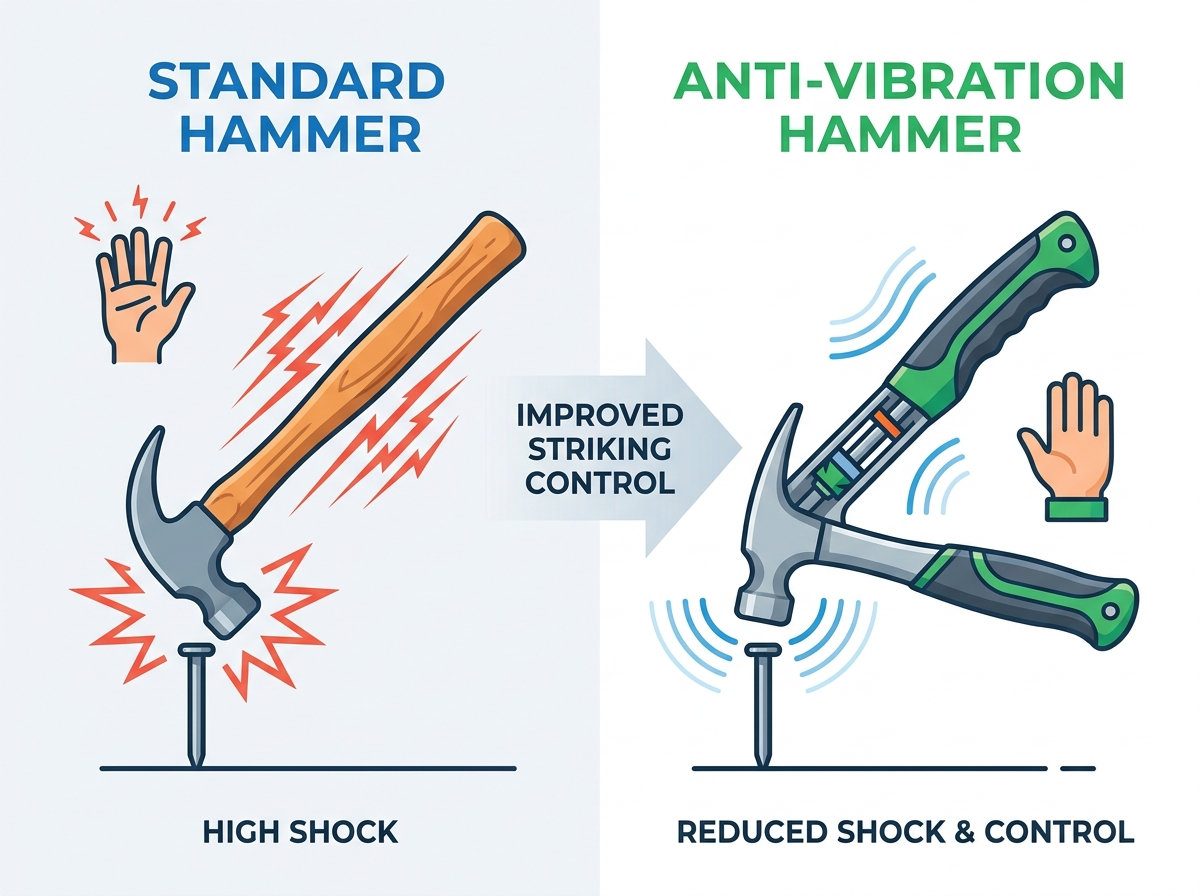
Every hammer strike involves a rapid transfer of kinetic energy. When the steel head impacts a nail or a dense piece of engineered lumber, the objective is to drive that energy forward. Physics dictates that not all energy successfully transfers into the target material. The remaining force rebounds instantly. This unabsorbed energy travels backward as high-frequency vibration waves down the handle.
These vibration waves act as kinetic shock. When a hammer lacks structural dampening, your hand and arm become the primary shock absorbers. The human musculoskeletal system is not built to absorb high-frequency recoil continuously. Soft tissues, tendons, and ligaments take the brunt of this force. Driving 16d sinkers into LVL beams all day with a solid steel hammer forces your body to absorb thousands of these micro-impacts. This constant absorption causes micro-tears in the forearm muscles and strains the elbow joint.
Effective vibration control changes this dynamic completely. When a hammer successfully dampens vibration, less energy is lost to handle resonance. This creates a massive efficiency gain. More kinetic energy is directed straight into driving the nail. You hit harder with less effort. Consequently, the physiological impact drops dramatically. Reducing the vibration frequencies prevents the rapid onset of muscle fatigue and protects against chronic strain injuries.
Striking tools vary wildly in their design and application. A standard claw hammer features a specific striking face for driving nails and a curved or straight claw for extracting them. General or specialty hammers, such as rubber mallets, ball-peen hammers, or heavy club hammers, serve entirely different functions. They are built for shaping metal, assembling delicate parts, or delivering blunt demolition force.
Understanding the difference between a general hammer and a claw hammer highlights why vibration management is a unique engineering challenge. A claw hammer is a dual-purpose tool. It must drive nails efficiently, but it must also act as a powerful lever. Pulling embedded galvanized nails requires immense handle rigidity. The shaft must withstand extreme bending forces without snapping.
This need for high rigidity directly conflicts with standard shock absorption. Highly flexible materials absorb shock well but fail under heavy prying loads. General striking tools do not require this prying leverage, allowing them to use highly flexible handles. Claw hammers require a precise balance. Engineers must design a shaft rigid enough for nail extraction but advanced enough to interrupt high-frequency shock waves during heavy striking.
Material science forms the foundation of modern vibration control. Traditional solid wood handles offer moderate natural dampening but lack extreme durability on rough job sites. Single-piece forged steel handles offer maximum durability but transmit shock almost entirely unhindered. Modern alternatives solve this problem by utilizing materials engineered specifically to disrupt kinetic energy.
Fiberglass handles naturally absorb and dissipate shock waves highly effectively. The composite fibers flex at a microscopic level upon impact. This flex scatters the kinetic energy before it travels the full length of the shaft. Fiberglass provides a high strength-to-weight ratio, making it ideal for continuous daily use in framing and formwork.
Titanium represents the premium tier of material dampening. Titanium is significantly less dense than steel but offers comparable strength. It efficiently disperses kinetic energy while drastically reducing overall head and shaft weight. A lighter hammer head moving at a higher velocity generates the same striking force as a heavier steel head. This weight reduction, combined with titanium's natural shock-dissipating properties, minimizes fatigue and joint strain simultaneously.
Handle Material | Shock Absorption | Prying Durability | Weight Profile | Best Jobsite Application |
|---|---|---|---|---|
Solid Forged Steel | Poor | Excellent | Heavy | Heavy Demolition / Concrete Forms |
Hickory Wood | Moderate | Moderate | Light | Light Framing / Finish Carpentry |
Fiberglass Composite | High | Good | Medium | General Construction / Daily Framing |
Titanium | Excellent | Excellent | Very Light | High-Volume Production Framing |
Materials alone cannot eliminate all vibration. Advanced structural engineering is required to interrupt and cancel out specific vibration frequencies. Manufacturers utilize internal handle designs to achieve this. One common method is the tuning fork shape hidden within the shaft. When the hammer strikes, the vibration wave splits down the two prongs of the internal fork. These waves cross and cancel each other out through destructive interference.
Other designs utilize hollow cores or internal dampening rods. A hollow core filled with shock-absorbing foam traps vibrations inside the shaft. Dampening collars placed directly beneath the hammer head isolate the steel from the handle entirely. This physical break in the material prevents the initial shock wave from ever entering the grip section.
The exterior grip also plays a critical mechanical role. Thermoplastic rubber (TPR) and specialized elastomers are molded over the base shaft. These materials isolate your hand from residual micro-vibrations. Furthermore, textured grip designs ensure a secure, slip-resistant hold. A secure grip prevents you from employing a "death grip" on the tool. Over-gripping a hammer severely accelerates hand and forearm fatigue. Proper elastomers allow for a relaxed, controlled swing.
To verify the structural dampening of a tool in the field, follow these inspection steps:
Inspect the neck transition just below the hammer head for visible dampening collars or structural breaks.
Check the manufacturer specifications for internal core designs like tuning forks or hollow chambers.
Evaluate the grip over-mold to ensure it is made of thick, compressible TPR rather than hard plastic.
Strike a solid piece of lumber and feel for the duration of the resonance in your palm.
Internal anti-vibration mechanisms inherently alter a tool's center of gravity. A solid steel hammer carries weight evenly down the shaft. A composite or hollow-core hammer concentrates the weight at the head. This forward-weighted balance alters the overall swing momentum. It allows gravity and leverage to do more of the work during the downward arc.
Better balance translates directly to improved swing dynamics. You exert less physical force to achieve the same driving power. This efficiency gain is mandatory for high-volume tasks. When the hammer does the work, your arm muscles stay fresh longer. You can drive nails at the end of a ten-hour shift with the same power as you did in the first hour.
There is a direct correlation between reduced hand fatigue and sustained striking accuracy. Shock absorption keeps the forearm muscles relaxed. Relaxed muscles provide better fine motor control. When your arm is not vibrating and cramping from recoil, you can consistently hit the nail head squarely. This control prevents bent nails, damaged wood surfaces, and glancing blows that can cause injury.
Hammer design always involves a structural trade-off. Highly flexible, shock-absorbing composite handles excel at dampening vibration. However, they may sacrifice the extreme rigidity required for heavy prying or aggressive demolition tasks. If a handle flexes too much during nail extraction, it loses leverage and risks structural failure.
Evaluating this trade-off is essential for professionals. A fully composite shaft is ideal for repetitive driving tasks where shock absorption is the absolute priority. For heavy framing or demolition, a stiffer shaft with localized dampening is often preferable. These designs utilize a rigid steel or thick fiberglass core for prying strength but incorporate dampening collars and thick TPR grips to manage the recoil.
You must assess your primary daily tasks. If you spend ninety percent of your day driving nails and ten percent pulling them, prioritize maximum shock absorption. If you frequently use your hammer as a pry bar to separate heavy lumber, prioritize shaft rigidity and look for advanced internal dampening rather than shaft flexibility.
Selecting a tool requires matching the technology to the task. Choosing the right claw hammer demands a realistic assessment of your daily workload frequency and intensity. A trim carpenter hanging doors has vastly different needs than a framer building roof trusses.
Head weight is the first variable. A 16oz finish hammer provides excellent control for delicate work but lacks the mass for driving large framing nails. A 22oz framing hammer drives heavy nails easily but will quickly fatigue your arm if swung all day. Advanced materials change this equation. Titanium and advanced composites allow you to swing a lighter hammer with the same driving force as a heavier steel model. Swinging a 14oz titanium hammer delivers the impact of a 21oz steel hammer. This drastically reduces overall shoulder strain without sacrificing productivity.
Evaluate the claw style as well. A curved claw provides excellent leverage for pulling nails without marring the wood surface, making it ideal for finish work. A straight rip claw is designed for driving between boards to pry them apart, making it the standard choice for rough framing and demolition.
The tool market is saturated with misleading marketing claims regarding vibration reduction. A simple rubber sleeve slipped over a solid steel shaft is entirely insufficient for true, measurable vibration reduction. Steel is inherently prone to transmitting shock. A thin layer of rubber only cushions the skin; it does not stop the kinetic energy wave from traveling into your bones and joints.
True anti-vibration tools rely on structural engineering. Look for specific structural indicators when evaluating a purchase. Multi-material construction is a primary indicator of quality. Verified dampening technologies, such as tuning forks or isolated head designs, should be clearly documented by the manufacturer.
Inspect the connection point between the head and the handle. If it is a single, continuous piece of steel without any visible dampening inserts or structural breaks, its shock-absorbing capabilities are likely superficial. Demand engineered solutions, not just cosmetic rubber grips.
Switching to a highly vibration-dampened hammer involves a noticeable learning curve. This is especially true when transitioning to lighter materials like titanium. Traditional steel hammers require heavy muscular force to initiate and stop the swing. Advanced hammers rely on velocity and forward-weighted balance.
Users often over-swing titanium or composite hammers initially. They apply the same force they used with their heavy steel tools. This over-swinging negates the ergonomic benefits and can cause immediate muscle soreness. You must adjust your swing mechanics. Let the speed of the lighter head and the balance of the tool do the work. A relaxed grip and a fluid, snapping motion at the wrist will maximize efficiency and allow the dampening technology to function properly.
Multi-piece and composite anti-vibration handles introduce potential failure points not found in single-piece forged steel. Understanding these vulnerabilities ensures a longer tool lifespan. Delamination can occur in fiberglass shafts if the outer protective resin is deeply scratched or chipped. Epoxy failure at the head-to-handle joint is possible under extreme, unintended prying loads.
Grip wear is another reality. The soft elastomers that isolate micro-vibrations will eventually degrade from sweat, friction, and exposure to job site chemicals. Regularly check the epoxy seal beneath the hammer head for hairline cracks. Inspect composite shafts for splintering.
Maintain the rubberized components by keeping them clean of harsh solvents. If the TPR grip begins to peel or the internal dampening rods become loose, the tool's shock-absorbing efficacy is compromised. Replace the tool when structural integrity is in question to maintain grip security and vibration control.
An authentic anti-vibration claw hammer is a necessary investment for high-volume users. It directly mitigates the risk of long-term joint damage while sustaining daily accuracy and driving efficiency. Moving away from solid steel shafts protects your musculoskeletal system and extends your working career. Prioritize tools with structural dampening like tuning forks or composite shafts over those with only superficial rubber grips. Ensure the head weight and claw type align perfectly with your primary tasks, whether that involves heavy framing or precise finishing.
Audit your current daily usage to determine the exact ratio of driving versus heavy prying you perform on site.
Inspect your existing striking tools for signs of superficial rubber grips masking solid steel shafts.
Test the balance and swing mechanics of multi-material hammers in person to feel the center of gravity differences.
Upgrade to a model that features verified internal dampening structures tailored to your specific trade requirements.
Adjust your swing technique to rely on velocity rather than brute force when using lighter, advanced-material hammers.
A: Yes. Engineered anti-vibration hammers use internal structures and composite materials to absorb high-frequency kinetic shock before it reaches your hand. This prevents the micro-traumas in soft tissues that lead to chronic joint pain and muscle fatigue during repetitive striking tasks.
A: A claw hammer requires a highly rigid shaft to provide leverage for pulling embedded nails. This rigidity makes dampening vibration difficult. General hammers, like mallets, do not require prying leverage, allowing them to use highly flexible, naturally shock-absorbing handles without risk of breaking.
A: Fiberglass and advanced composites are superior for reducing vibration. Solid steel transmits shock directly to the user. Wood offers moderate natural dampening but lacks the extreme durability of modern composites. Titanium and fiberglass actively scatter and absorb kinetic energy.
A: By absorbing recoil, the hammer prevents rapid muscle fatigue in your forearm. Relaxed, unfatigued muscles maintain fine motor control longer. This allows you to consistently strike the nail squarely, directing maximum energy into the drive rather than losing it to handle vibration.
A: While no tool guarantees injury prevention, shock-absorbing hammers significantly reduce the specific high-frequency vibrations that cause lateral epicondylitis (tennis elbow). By mitigating the kinetic shock traveling up the arm, they drastically lower the risk of developing chronic tendon inflammation.
A: For framing, look for a forward-weighted balance, a straight rip claw for separating lumber, and structural dampening like a tuning-fork handle or titanium core. Ensure the grip uses thermoplastic rubber to prevent slipping and isolate residual micro-vibrations during heavy, continuous strikes.
A: Yes. The soft elastomers and thermoplastic rubber grips can degrade from friction, sweat, and chemical exposure. Additionally, heavy misuse can cause internal epoxies or composite fibers to micro-fracture. Regular inspection is required, and tools should be replaced if the grip loosens or the shaft splinters.