- All
- Product Name
- Product Keyword
- Product Model
- Product Summary
- Product Description
- Multi Field Search

Views: 0 Author: Site Editor Publish Time: 2026-10-26 Origin: Site


Walking down the tool aisle often feels overwhelming for both DIY beginners and aspiring mechanics. You stare at rows of shiny metal tools, wondering which specific option fits your upcoming project. Investing in the wrong size routinely leads to snapped fasteners, inaccessible workspaces, or simply wasted money on redundant equipment. Many people grab the largest kit they see, assuming bigger automatically means better. This common mistake leads to intense frustration during actual repair jobs. We need to demystify torque limits, physical clearance constraints, and precise application profiles. Understanding these factors ensures you invest in the correct tool for your specific mechanical needs. This comprehensive guide breaks down the operational realities of the three primary socket drive sizes based on standard mechanical practices. We will explore engineering differences, clearance trade-offs, and practical applications. You will learn exactly how to build your toolkit smartly to tackle any repair job confidently.
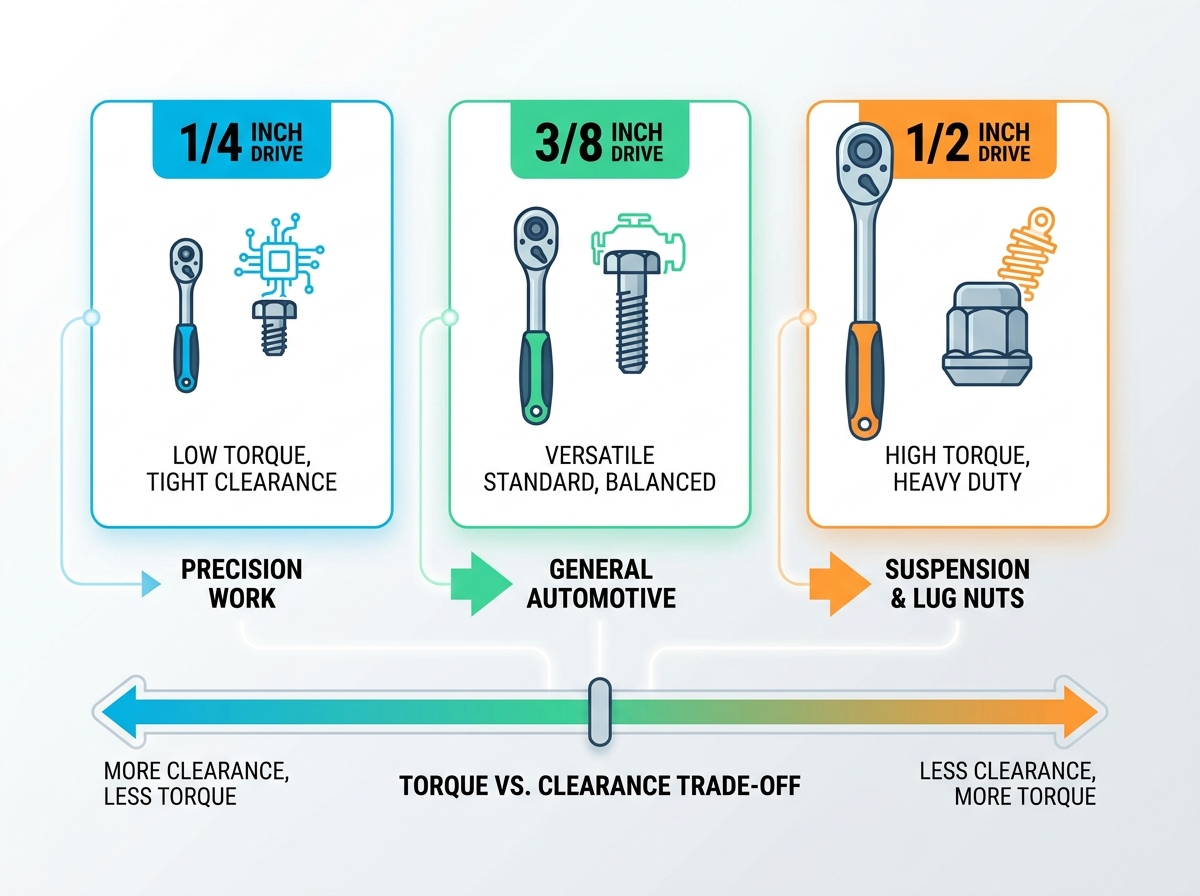
1/4-inch drives are strictly for low-torque, tight-clearance work (interior trim, small electronics, bicycles).
A 3/8 inch socket set is the most versatile starting point, handling roughly 80% of standard automotive and household maintenance.
A 1/2 inch socket set is mandatory for heavy-duty applications requiring high torque (lug nuts, suspension components, rusted heavy bolts).
Mixing drive sizes using adapters is a temporary fix, not a long-term solution, as it compromises torque delivery and increases the risk of tool failure.
When mechanics mention "drive size," they refer to a specific square component. You will find this square anvil protruding directly from the ratchet head. This anvil locks securely into a matching square recess inside your tool. It dictates the wall thickness and the overall physical geometry of the attached component. Smaller anvils pair up perfectly alongside much thinner metal walls. Larger anvils demand significantly thicker steel construction. This thicker metal absorbs intense rotational force safely without bursting. Engineers design these dimensions based on rigorous stress tests. They know exactly how much twisting force a particular piece of steel can handle before breaking.
Every mechanic must respect one foundational physical rule regarding tool selection. Larger drives handle exponentially more torque. However, they require significantly more physical space to operate effectively. You cannot cheat basic physics. Thick metal handles heavy stress easily during tough jobs. Yet, bulky tools simply cannot squeeze into narrow engine gaps or behind interior panels. We must constantly balance pure strength against available working room. Choosing the right tool means evaluating the surrounding physical environment first.
When evaluating this trade-off, consider these three core principles:
Fastener diameter directly influences the required torque limit.
Surrounding obstacles dictate your maximum allowable tool thickness.
Thread pitch determines how carefully you must apply rotational force.
Different square anvils accommodate specific ranges of nuts and bolts. We have outlined the native ranges usually available for each square anvil type below.
Fastener Compatibility Matrix
Drive Size | Common Metric Range | Typical Application Profile |
|---|---|---|
1/4-inch | 4mm - 14mm | Low torque, high precision tasks |
3/8-inch | 8mm - 24mm | Medium torque, versatile maintenance |
1/2-inch | 10mm - 32mm+ | Heavy duty, high leverage tasks |
These miniature tools excel dramatically in confined, frustrating spaces. You will reach for them frequently during dashboard or interior trim removal. Modern engine bays pack delicate sensors, wiring harnesses, and hose clamps tightly together. You absolutely need a small tool profile here. Bicycles and small engine repair jobs also demand these highly compact dimensions. Think about maintaining lawnmowers, chainsaws, and delicate motorcycle fairings. A bulky tool would instantly crack the surrounding plastic housings.
These miniature ratchets fit easily into deeply recessed or obstructed areas. Larger handles simply cannot swing freely in these cramped zones. They provide highly sensitive tactile feedback through the handle. You can actually feel the fastener threading perfectly into the hole. This immediate physical feedback prevents accidental over-tightening of small parts. Stripping delicate aluminum threads becomes much less likely. You maintain total control over the clamping force at all times.
You face significant tool failure risks under heavy mechanical loads. Users often snap the square anvil by applying excessive force. The fastener head itself may break off completely, leaving a ruined thread. Avoid using these delicate tools on anything requiring more than 20 to 25 ft-lbs of torque.
Common failure scenarios include:
Applying your full body weight onto the small handle.
Attempting to loosen rusted undercarriage bolts.
Using excessive leverage on engine mounts.
Striking the ratchet head with a heavy hammer.
Treat this size strictly as a secondary tool purchase. Buy it specifically for specialized, intricate work. Most beginners should avoid starting their overall collection here. Wait until your projects specifically demand miniature dimensions. It shines brightest when you already own larger tools for heavy lifting.
This middle tier handles most general mechanical tasks effortlessly. You will use it for general automotive repair continuously throughout your projects. It removes spark plugs, alternators, and brake calipers effectively. Furniture assembly goes much faster using this specific size. Light to medium motorcycle maintenance relies heavily on this tier. It bridges the gap between delicate interior work and heavy suspension repairs perfectly.
Many experienced mechanics consider this the absolute "Goldilocks" size. It offers enough leverage to break loose moderately stubborn bolts. Simultaneously, it remains compact enough for most modern engine bay work. You truly get the best of both mechanical worlds. The handle length provides excellent mechanical advantage for stubborn parts. Meanwhile, the head profile still squeezes past bulky radiator hoses and bulky air intakes.
This highly versatile option still has distinct physical limitations. It struggles against severely rusted undercarriage bolts or corroded exhaust clamps. Users sometimes slide a hollow metal tube over the handle to cheat. This "cheater pipe" increases leverage drastically, multiplying the force applied. Unfortunately, this trick often leads directly to internal gear failure. The internal ratcheting mechanism simply cannot survive extreme mechanical overload.
Every new mechanic needs a solid, dependable starting point. If you are buying your very first tool kit, start right here. A comprehensive 3/8 inch socket set provides massive long-term value. It stands as the statistically safest and most useful financial investment. You will complete roughly 80 percent of standard maintenance jobs effortlessly. Start building your entire collection around this core foundation.
Heavy tasks require massive chunks of reinforced steel. You must use this category for stubborn automotive lug nuts. Suspension geometry and robust steering components demand this extreme level of strength. Heavy machinery repair requires substantial leverage to overcome industrial friction. Breaking loose severely seized fasteners remains impossible without this size. When rust welds a bolt shut, you need maximum physical force.
These massive tools provide incredible torque capacity for tough situations. Engineers build them specifically to handle long breaker bars. They survive severe leverage without bending, warping, or failing under pressure. Thick metal walls grip large hex heads securely during operation. You can apply your entire body weight safely to loosen stuck parts. The internal ratcheting teeth rarely slip under immense physical pressure.
This massive size represents total overkill for tiny fasteners. Using a 1/2 inch socket set on a tiny 10mm bolt causes instant disaster. It almost guarantees the bolt head will shear right off the shank. The user simply cannot feel the torque limit approaching through the thick handle. Furthermore, the bulky ratchet head proves too large for tight engine compartments. It constantly bumps against surrounding metal brackets.
This size remains absolutely essential for ambitious weekend DIYers. Anyone performing heavy suspension work or seasonal tire rotations needs one. However, it serves a highly specific, heavy-duty purpose. You should always pair it alongside a smaller, more nimble collection. Use the big tools specifically for breaking things loose. Switch immediately to smaller handles for delicate, general reassembly tasks.
Your daily workflow dictates your ideal purchasing path. Follow these generalized paths based on your specific technical hobby:
Automotive DIY and Mechanics: Start your journey by purchasing a versatile 3/8-inch kit. Add a heavy 1/2-inch kit for tough suspension work later. Finally, grab a precise 1/4-inch kit for delicate interior trims.
Homeowners and Furniture Assembly: Buy a basic 3/8-inch kit for general repairs. Alternatively, invest in a high-quality multi-bit screwdriver kit for simple household jobs.
Bicycle Mechanics: Stick primarily to the precise 1/4-inch tier. Always pair it alongside a dedicated, calibrated torque wrench to protect fragile carbon fiber frames.
Many eager buyers fall into a classic financial trap. They buy one large kit and rely heavily on cheap adapters. This false economy creates massive frustration during complex repairs. Stepping down forces a large, heavy handle onto a tiny fastener. The excessive leverage snaps the adapter or shears the bolt instantly. Stepping up creates an entirely different mechanical problem. You attach a tiny, weak handle to a massive rusted bolt. The small handle prevents necessary torque delivery entirely. You simply cannot push hard enough to break the rust seal.
Smart tool buyers prioritize long-lasting quality over pure quantity. Do not buy cheap, low-quality versions of all three sizes simultaneously. Instead, allocate your tool budget toward your primary daily workhorse. We strongly recommend prioritizing high tooth-count ratchets for your main kit. Ensure you purchase robust 6-point designs for your primary working size. A premium 3/8-inch collection outperforms three cheap, unreliable sets easily. Quality tools save immense time and prevent ruined fasteners.
Building a reliable tool collection requires strategic, logical planning. You must align the tool's torque capacity alongside its physical footprint. Match these attributes directly against your specific mechanical task. Avoid the temptation of a "one size fits all" approach. Complex projects require varied levels of strength and precision. Start your journey by acquiring a high-quality 3/8-inch kit. This provides maximum immediate return on investment for general tasks. As your skills grow, scale your collection up or down appropriately. Project demands will naturally dictate your next logical tool purchase.
A: Yes, but you must use specifically rated impact sockets. Manufacturers usually craft these from Cr-Mo (Chromium-Molybdenum) steel. You will most commonly find them in 1/2-inch and 3/8-inch drive sizes. Never use standard chrome sockets on impact tools. Chrome shatters under sharp impacts, creating a severe safety hazard.
A: Always use a 1/2-inch drive. Standard wheel installation requires between 80 and 150 ft-lbs of torque. Smaller 3/8-inch drives do not safely support this extreme rotational force. A 1/2-inch breaker bar provides the exact leverage needed for safe tire maintenance.
A: We strongly recommend 6-point models for high-torque applications. They grip the flat sides of the bolt securely. This action prevents the fastener corners from rounding off. However, 12-point models remain incredibly useful for tight, low-torque positioning where ratchet swing space is severely limited.
A: They remain perfectly safe for light duty tasks. However, they introduce a distinct weak point into your tool chain. Under heavy stress, the adapter often shatters before the bolt turns. It is always safer to match the drive size directly to the specific fastener requirements.