- All
- Product Name
- Product Keyword
- Product Model
- Product Summary
- Product Description
- Multi Field Search

Views: 0 Author: Site Editor Publish Time: 2026-10-14 Origin: Site


Selecting the wrong cutting tool does not just result in a poor cut. It can permanently damage expensive equipment, ruin critical materials, and create severe safety hazards on the job site. You might think heavy jaws handle any thick material. However, this assumption leads many professionals to make costly field mistakes. Both devices rely on mechanical advantage to sever thick materials. Yet, their engineering principles dictate entirely different applications. One slices cleanly through soft metals. The other crushes hardened steel via immense force. You must match the jaw mechanics to the specific metallurgical properties of your workpiece. This guide provides a technical breakdown of material compatibility, cut quality, and operational efficiency. You will learn how blade designs interact with various metals. Ultimately, we will help you finalize your tooling decision based on concrete engineering principles rather than guesswork.
Ratchet cable cutters utilize a step-by-step shearing action designed for clean cuts on soft metals like copper and aluminum, ensuring cables fit precisely into electrical lugs.
Bolt cutters use compound leverage to crush through hardened materials like steel chains, rebar, and padlocks.
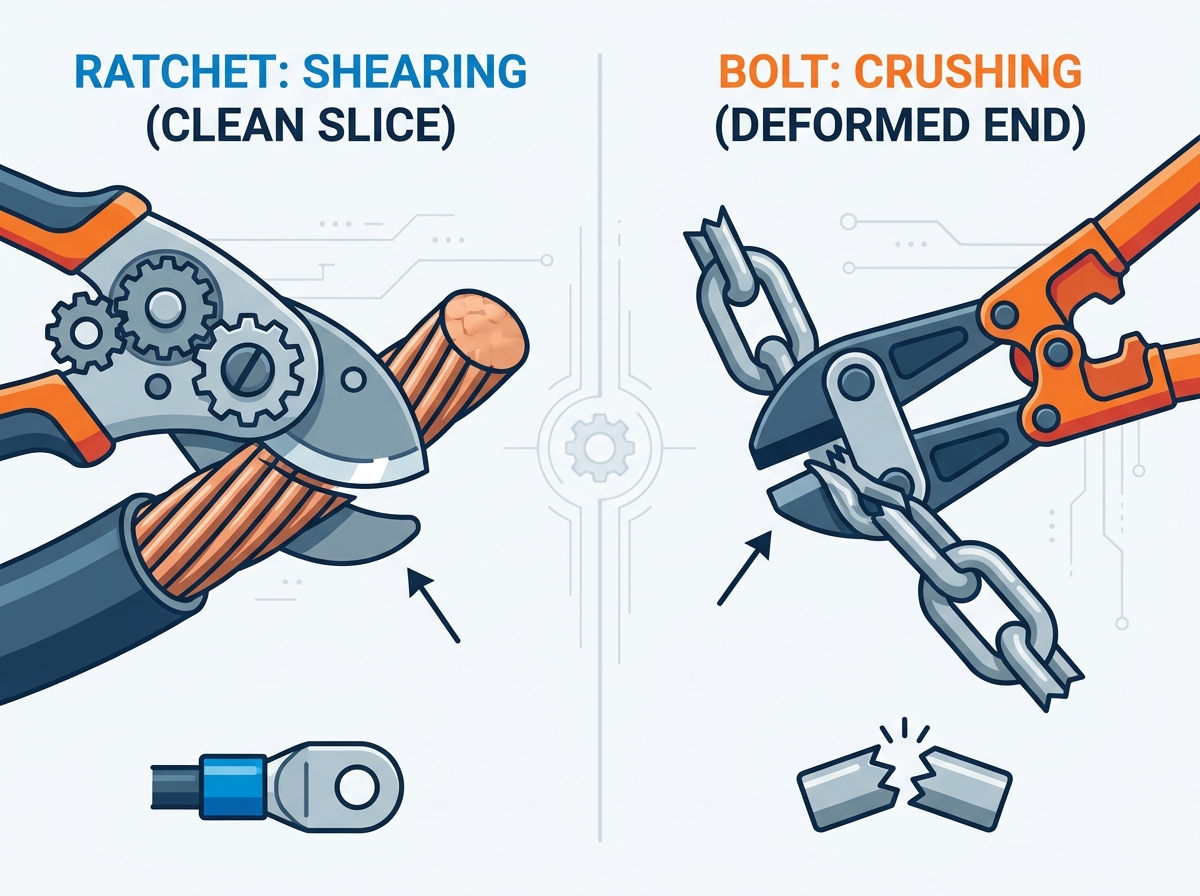
Using a bolt cutter on electrical wire flattens the core, compromising terminations, while using a ratchet cable cutter on steel will immediately chip or shatter the cutting blades.
Tool selection should be driven strictly by material hardness, required cut profile (clean vs. raw), and spatial constraints in the working environment.
We must explore the mechanical physics inside these tools. Understanding the mechanics prevents improper application. Let us look at how they generate cutting force.
A ratcheting tool operates much like a mechanical saw blade. It utilizes a specialized gear system to advance the cutting jaw incrementally. You squeeze the handles repeatedly. Each squeeze clicks a geared tooth forward. A locking pawl holds the jaw in place while you release the handles. This design creates a massive mechanical advantage over a prolonged period. The mechanism allows for effortless one-handed operation. It applies sustained, concentrated pressure to the material. The curved blades bypass each other tightly. They slice through the metal strands rather than smashing them. This shearing action leaves a perfectly round profile. You avoid pinching or deforming the internal structure of the wire.
Crushing tools rely on brutal, instantaneous force. You will notice a distinct pivot-joint design on a heavy duty bolt cutter. This linkage system multiplies your manual force exponentially. You pull two long handles together simultaneously. The compound hinges transfer this massive energy directly to the cutting head. The jaws do not bypass one another. Instead, they meet squarely in the center. They act as blunt wedges. The jaws push the metal apart until it overcomes the tensile strength of the hardened steel. The material eventually fractures and snaps. It forces the material apart rather than cleanly slicing it. This action destroys the shape of softer materials.
Professionals choose this tool for precision electrical work. You must preserve the physical integrity of the conductor before terminating it.
Electricians rely heavily on ratcheting mechanisms. You use them primarily for cutting large-gauge copper, aluminum, and communications cables. They easily handle massive sizes like 500 MCM or 1000 MCM. The primary success criterion is cut geometry. You often face situations requiring a perfectly round cut profile. You need this clean edge for immediate termination into ferrules, lugs, or standard connectors. You cannot afford secondary reshaping steps. If the wire flattens, it will not fit into the terminal block.
To ensure operational success, verify these conditions:
The target material consists entirely of soft metals.
The downstream connection requires strict geometric tolerances.
The workspace limits your range of physical motion.
These cutters offer a distinct compact footprint. You can easily maneuver them inside tight electrical panels, deep trenches, or cramped ceiling grids. They only require one hand to operate. This leaves your other hand free to stabilize the wire. Furthermore, they provide massive ergonomic benefits. The ratcheting gear handles the heavy lifting. This significantly reduces user fatigue during repetitive cuts. Manual lopper-style tools demand tremendous upper-body strength. Ratcheting tools eliminate this physical strain entirely.
You must respect the material limitations of this design. Standard blades are typically not hardened for steel. The sharp, thin cutting edges prioritize slicing over durability. Cutting ACSR (Aluminum Conductor Steel Reinforced) or steel guy wires requires a specially rated cutter. If you use a standard copper-rated blade on steel, catastrophic blade failure occurs. The steel core will immediately chip or shatter the cutting edge. This mistake ruins an expensive tool instantly. Always verify the cable composition before you begin clicking the handles.
Sometimes, raw destruction takes precedence over precision. You need a tool built for pure structural demolition.
These tools excel at severing padlocks, heavy chains, threaded rods, rebar, and high-tensile steel fencing. Construction crews and rescue personnel depend on them heavily. You use them for demolition or salvage tasks where aesthetics do not matter. The precision of the cut end is completely irrelevant. You simply need to separate two pieces of hardened metal quickly.
You achieve an instantaneous cutting action. This speed easily outpaces the slower ratcheting process. You place the jaws, squeeze the handles, and the metal snaps immediately. Furthermore, these jaws withstand extreme abuse. They handle the hardest common job-site materials without sustaining damage. The heavy, blunt edges resist chipping. They power through dirt, rust, and industrial grime effectively.
You must understand the flattening effect. Applying this tool to stranded copper wire creates a disaster. It smashes the delicate strands flat. It pushes the entire cable bundle completely out of round. This deformation renders the cable unusable for tight-tolerance electrical connections. You will spend hours trying to reshape the crushed end. Additionally, these tools require a wide operating angle. You must swing both handles widely to engage the compound hinges. They also demand two hands for operation. This drastically limits their utility in confined spaces.
Professionals frequently debate the exact boundaries between these tools. Conducting a comprehensive ratchet cable cutter vs bolt cutter comparison reveals stark contrasts. You must align the tool's mechanical properties with your project requirements.
Let us examine how these designs compete across key operational metrics.
Evaluation Metric | Ratcheting Mechanism | Compound Leverage Mechanism |
|---|---|---|
Material Hardness Compatibility | Soft, thick metals (copper, aluminum, communications wire). | Hardened steel, iron alloys (rebar, chains, padlocks). |
Cut Quality and Downstream Impact | Produces clean, round, termination-ready ends. Leaves no burrs. | Leaves deformed, pinched, or sharp burred ends. |
Space and Accessibility | Allows one-handed, low-clearance operation in tight spaces. | Requires high-clearance, two-handed leverage to fully open jaws. |
Speed vs. Precision | Slow, methodical slicing. Highly precise geometry. | Rapid, aggressive snapping. Zero precision required. |
Every professional must prioritize safety and maintenance. Misusing these tools creates hazards and drives up replacement budgets.
You must understand the critical difference between standard grips and VDE-rated/1000V insulated grips. Standard plastic dipping only offers ergonomic comfort. It provides zero protection against electrical shock. VDE-rated insulated grips undergo rigorous dielectric testing. Neither tool should ever be used on live circuits. You must always verify a circuit is dead before cutting. However, insulated ratchet cutters provide necessary compliance for specific electrical environments. They offer a vital secondary layer of protection against accidental energization. Bolt snappers rarely feature certified 1000V insulation because you rarely use them on conductive electrical infrastructure.
Proper upkeep dictates the long-term utility of your gear. Tool lifespan depends heavily on regular blade maintenance. Ratchet blades often detach easily. You can send them out to be sharpened. Alternatively, you can replace the blade cassette entirely. You must regularly clean the gear teeth. Light machine oil prevents the internal pawl from sticking. Conversely, compound leverage jaws rarely need sharpening. However, they require periodic physical adjustment. You must turn the eccentric cam bolts near the hinge. This adjustment realigns the cutting edges as the metal wears down over time. Without proper cam adjustment, the jaws will leave a tiny gap. They will fail to snap thinner materials cleanly.
You must strictly follow the manufacturer's capacity limits. Read the AWG or MCM ratings stamped on the handle. Do not exceed these dimensions. Forcing a ratcheting tool onto an oversized cable strips the internal gears. Provide strict instructions to your crew regarding steel-cutting prohibitions. If someone uses the slicing blades on a steel chain, they will void the warranty instantly. The blades will suffer irreversible micro-fractures. Train your personnel to identify ACSR cables visually. Distinguishing pure aluminum from a steel-reinforced core prevents immediate tool destruction.
Tool selection is not an "either/or" choice for a general toolbox. It is a highly specific selection based on the exact material being cut. You cannot substitute one for the other without risking damage to the workpiece.
Here are the critical next steps for your project:
If your goal is electrical connectivity and preservation of wire geometry, select a heavy duty cable cutter.
If your goal involves the raw destruction of hardened metals, invest in compound leverage jaws.
Always verify the internal core material of overhead wires before applying slicing blades.
Keep insulated tools segregated and inspected regularly to maintain electrical safety compliance.
Review the specific diameter and metallurgical makeup of your target material before purchasing. Matching the jaw mechanics to the metal guarantees a safer, faster, and more professional result.
A: No, unless it is explicitly rated for ACSR or steel wire rope. Standard blades are engineered for soft metals. If you attempt to cut standard steel, the blades will instantly chip, dull, or shatter completely.
A: Yes, it will sever it, but it will crush and deform the cable end. This flattening effect pushes the wire out of round, making it highly difficult to fit into standard electrical lugs without extensive manual reshaping.
A: It varies by model, but standard industrial units handle between 600 MCM and 1000 MCM copper or aluminum. Always check the stamped capacity on the tool handle before attempting a cut to avoid gear damage.
A: You maintain ratcheting models by lubricating the internal gears and pawls. For crushing tools, you must periodically adjust the jaw cam bolts to realign the cutting edges. Both require lightweight machine oil to prevent surface rust.